Best Chef Knife for Beginners
Buying your first chef knife should be exciting, but it can quickly become confusing. One knife costs $30, another costs more than $150, and both claim to offer excellent sharpness, comfort, and durability. Add terms such as high-carbon steel, edge retention, forged construction, and hardness ratings, and it’s easy to feel that you need a degree in knife-making before choosing one.

The good news? You don’t.
If you’re just getting comfortable in the kitchen, you probably don’t need an expensive professional knife. You need a dependable blade that feels comfortable, handles everyday ingredients, and doesn’t require complicated maintenance.
A good chef knife can become one of the most useful tools in your kitchen. It can chop onions, slice tomatoes, mince herbs, prepare vegetables, and handle many everyday meat-preparation tasks. Instead of reaching for a different knife every few minutes, you can use one versatile tool for much of your food preparation.
But the right choice depends on more than the brand name. Blade length, handle design, weight, balance, and maintenance all affect how a knife feels in everyday use.
In this guide, we’ll look at four popular models, explain what makes each one worth considering, and help you decide which features matter most. Whether you’re shopping on a tight budget, prefer a lightweight knife, or simply want something easy to look after, you’ll find practical advice to help narrow down your options.
What Makes a Good Chef Knife for Beginners?
A beginner-friendly chef knife doesn’t need fancy materials or a long list of technical features. It should do its job reliably and feel comfortable enough that you enjoy using it.
When you’re preparing everyday meals, you’ll probably spend more time chopping vegetables and slicing fruit than performing complicated professional techniques. A suitable knife should make those routine jobs easier without demanding too much attention.
Here are five things worth considering before buying your first one.
1. A Handle That Feels Comfortable and Secure
The handle is easy to overlook when you’re comparing product specifications, but it’s one of the most important parts of a knife.
Think about it: the blade does the cutting, but your hand controls the entire tool. If the handle feels too thick, slippery, or awkward, even a sharp knife can become unpleasant to use.
Look for a handle that allows you to maintain a relaxed, secure grip. Textured synthetic materials can be useful because they offer a practical surface and generally require less special care than some wooden handles.
Keep in mind that comfort is personal. A handle that feels great in someone else’s hand might not suit yours.
If you can, visit a kitchenware shop and hold a few knives before deciding. When buying online, check the handle material, dimensions, and customer feedback about grip and comfort.
2. A Blade Length You Can Control
Most traditional chef knives have blades around 8 inches long. This size offers a useful amount of cutting surface for vegetables, meat, and general kitchen preparation.
However, an 8-inch blade isn’t automatically the best choice for everyone.
A 6-inch knife may feel more manageable if you have a smaller cutting board, prefer compact kitchen tools, or simply feel more confident with a shorter blade. It can handle many everyday tasks, although cutting larger ingredients may take a little more effort.
Think about the food you prepare and the space you work in. Don’t choose a longer knife just because it’s the most common size.
3. Practical Stainless Steel
For many first-time buyers, stainless steel is a sensible starting point.
It generally offers good resistance to corrosion and is relatively straightforward to care for. You still need to wash and dry your knife after use, but you won’t have to be as cautious about moisture as you would with many traditional carbon steel blades.
Not all stainless steel knives perform alike. The steel grade, heat treatment, blade geometry, and manufacturing quality all influence how a knife cuts and holds its edge.
You don’t need to become an expert in steel specifications before making your first purchase. A well-made stainless steel knife from a reputable manufacturer can be perfectly suitable for everyday home cooking.
4. A Weight That Suits Your Hand
Some chef knives feel light and nimble, while others have a heavier, more substantial feel.
A lighter knife may feel easier to move during repeated chopping, particularly if you’re still developing your technique. A heavier knife may feel more stable to someone who prefers a little extra weight.
Neither design is automatically better.
Pay attention to how the knife feels when you hold it. You should be able to guide the blade comfortably without constantly adjusting your grip or feeling that the knife is difficult to control.
5. Maintenance You Can Manage
Every chef knife needs some care. The difference is how much attention it requires and how comfortable you feel maintaining it.
For a first purchase, a conventional stainless steel blade with a standard straight edge is a practical option. It doesn’t usually demand the specialized care associated with some unusual blade designs or traditional carbon steel knives.
You’ll still need to clean it, dry it, store it safely, and sharpen it when its cutting performance declines.
A little basic maintenance goes a long way towards keeping a knife useful.
How We Selected These Chef Knives?
A product recommendation should explain why a knife deserves consideration, not simply repeat the claims printed on its packaging.
For this guide, we selected four established chef knife models that offer different approaches to everyday home cooking. We looked at their published specifications, handle materials, blade lengths, construction, and manufacturer care information.
Our selection considered:
- Blade length: Whether the size is practical for everyday food preparation.
- Handle design: The materials and grip features that may affect comfort and handling.
- Construction: Whether the knife uses stamped or forged construction.
- Maintenance: The manufacturer’s guidance on cleaning, sharpening, and everyday care.
- Intended use: Whether the knife makes sense as a general-purpose kitchen tool.
- Published specifications: Product details provided by the manufacturers.
A note about testing: These recommendations are based on product research and published manufacturer information. We have not personally tested every knife in this comparison, so we don’t claim hands-on experience or laboratory performance results. Individual comfort and cutting performance can vary depending on the user, technique, and maintenance.
Before ordering, check the exact model number and specifications on the retailer’s listing. Manufacturers sometimes sell several versions within the same product range.
Best Beginner-Friendly Chef Knives: Our Top Four Picks
You don’t need a drawer full of knives when you’re starting out. One suitable chef knife can handle a large share of everyday food preparation.
Still, different buyers have different priorities. You might care most about grip, price, weight, or the overall design.
Here are four models worth comparing.
Quick Comparison: Four Chef Knives
| Chef knife | Blade length | Main feature | Worth considering if you want… |
|---|---|---|---|
| Victorinox Fibrox Pro | Approx. 7.9 inches | Textured handle | A practical everyday knife |
| Mercer Millennia | 8 inches | Textured grip and finger guard | Useful features at a value-focused price |
| WÜSTHOF Gourmet | 8 inches | Lightweight German-made design | A traditional German-style option |
| Victorinox Swiss Classic | Approx. 7.9 inches | Lower listed weight | A lighter everyday knife |
Specifications refer to the particular models discussed below. Prices and availability vary by retailer and location.
1. Victorinox Fibrox Pro 8-Inch Chef’s Knife – Best Overall Starting Point
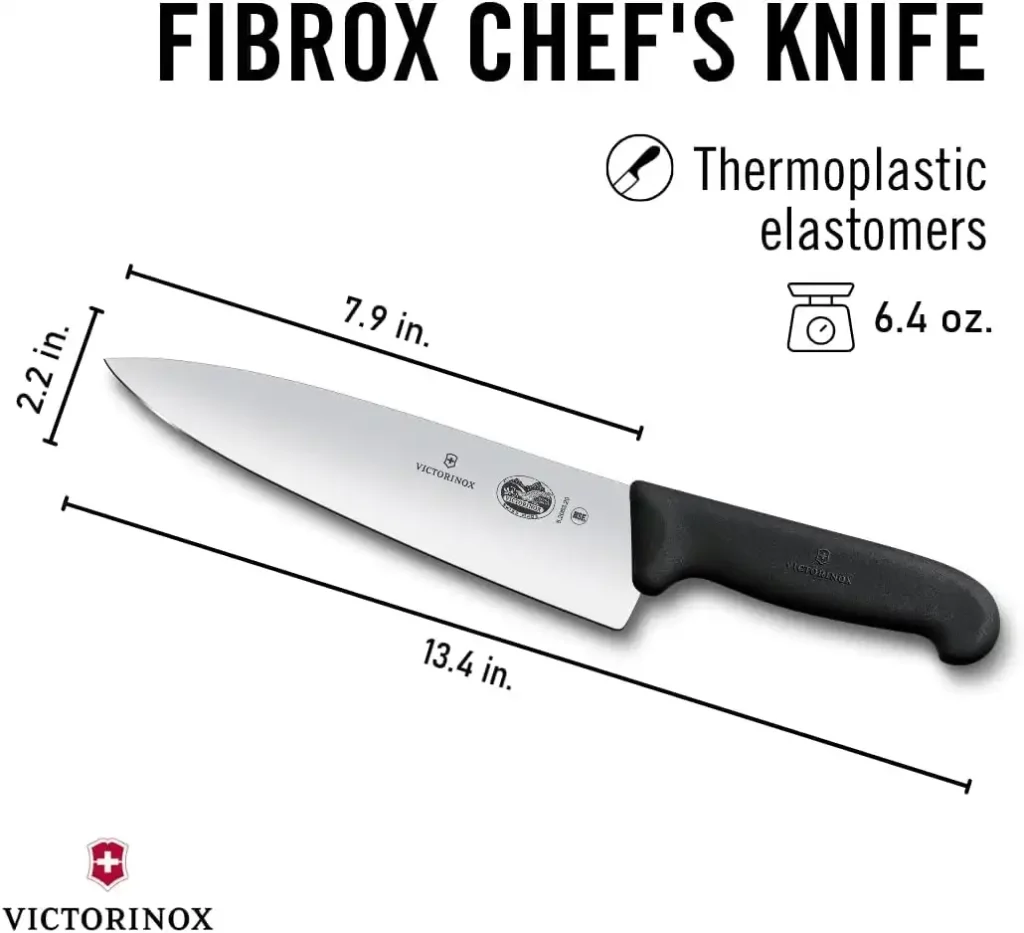
The Victorinox Fibrox Pro 8-inch chef knife is a practical option for someone who wants a dependable everyday knife without paying for unnecessary extras.
Its design is straightforward: a wide blade paired with a textured thermoplastic elastomer (TPE) handle. The handle is designed to provide a secure grip, while the broad blade gives you useful cutting space for chopping and slicing.
Victorinox lists the blade at approximately 7.9 inches and the knife’s weight at 6.4 ounces.
That makes it worth considering if you want a full-size chef knife without a particularly heavy feel. Its practical design also means you don’t have to worry about maintaining an elaborate finish or unusual blade shape.
What makes it worth considering:
- Textured handle designed for a secure grip.
- Approximately 7.9-inch blade.
- Lightweight stamped construction.
- TPE handle material.
- Straight edge for general kitchen preparation.
Where it may fall short:
The Fibrox Pro has a functional appearance rather than a decorative, premium look. Its handle may also feel bulky if you prefer slimmer grips or have smaller hands. If possible, compare its handle with other models before buying.
Who should consider it?
Home cooks looking for a practical, full-size chef knife for regular chopping, slicing, and dicing.
Our verdict: The Fibrox Pro deserves a place on your shortlist if everyday practicality and a textured grip matter more to you than appearance.
2. Mercer Culinary Millennia 8-Inch Chef’s Knife – Best Value-Focused Option
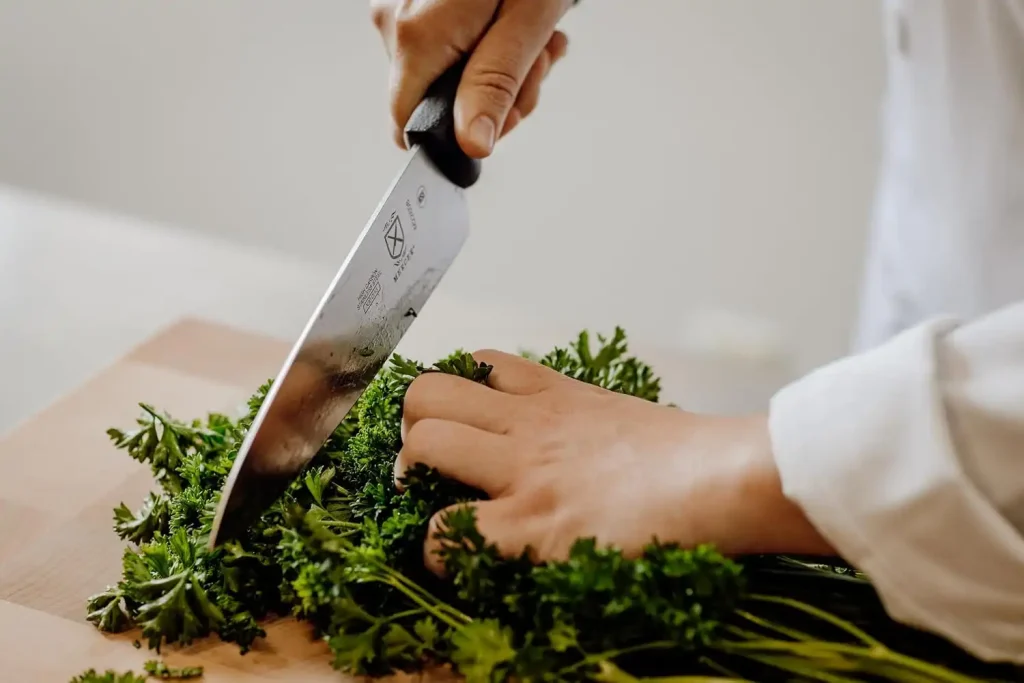
The Mercer Culinary Millennia 8-inch chef knife is another practical option, particularly if you’re comparing knives with useful handling features rather than looking for a premium finish.
It combines a high-carbon Japanese steel blade with a handle made from Santoprene and polypropylene. Mercer also includes textured finger points and a protective finger guard.
Those details make the Millennia interesting for someone who wants a functional design. The textured areas are intended to improve grip, while the finger guard adds a protective feature near the blade.
One point worth mentioning is Mercer’s description of the blade’s maintenance. The manufacturer highlights easy edge maintenance and rapid sharpening, which may appeal to buyers who don’t want an unnecessarily complicated sharpening routine.
What makes it worth considering:
- High-carbon Japanese steel blade.
- Santoprene and polypropylene handle.
- Textured grip areas.
- Protective finger guard.
- Manufacturer-described easy edge maintenance.
- Available in multiple blade lengths across the Millennia range.
Where it may fall short:
Its appearance is more functional than decorative, so it may not appeal to buyers who want a traditional premium-looking knife. Also, check the exact model before ordering because the Millennia range includes different blade lengths.
Who should consider it?
Beginners who want practical grip features and a straightforward design for everyday kitchen work.
Our verdict: The Millennia is worth comparing with the Fibrox Pro if you’re looking for a value-focused knife with useful handle features. Check current prices and the exact model specifications before making your choice.
3. WÜSTHOF Gourmet 8-Inch Chef’s Knife – Best Lightweight German-Style Option
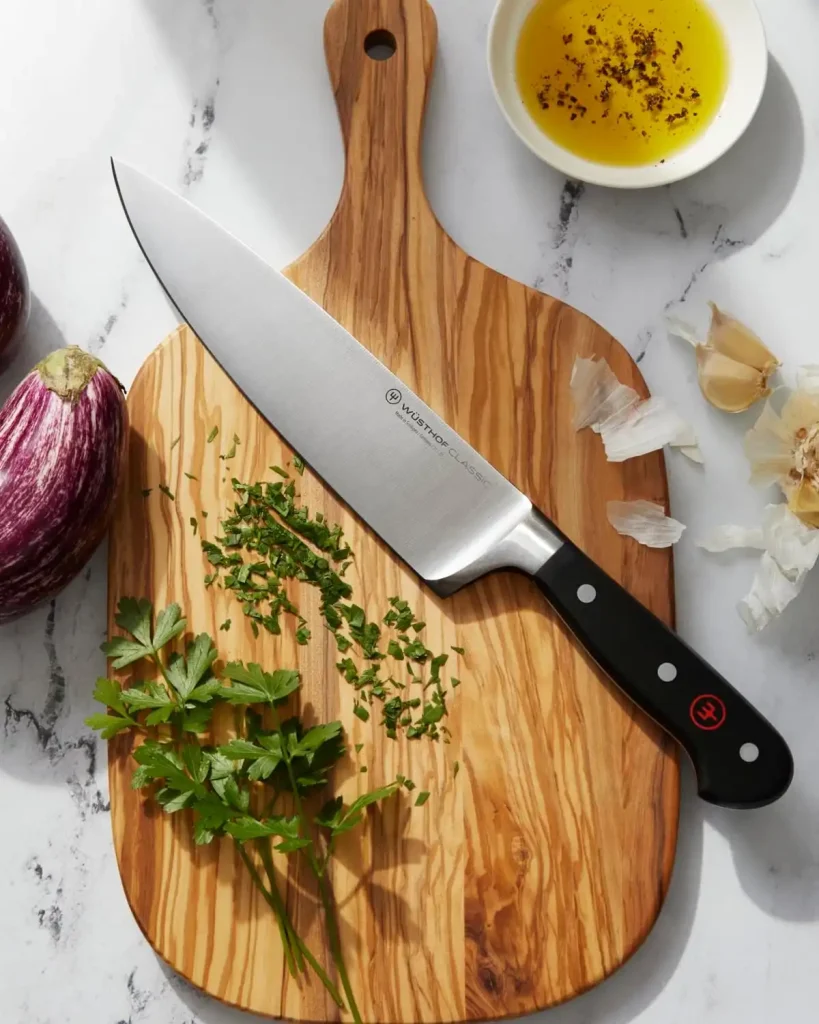
If you like the traditional appearance of German-style chef knives but don’t necessarily want a particularly heavy blade, the WÜSTHOF Gourmet 8-inch chef knife deserves a closer look.
The Gourmet series uses laser-cut, non-forged construction. This particular chef knife is made in Germany and features a synthetic handle with a traditional three-rivet appearance.
According to WÜSTHOF, the blade has a hardness rating of 56 HRC and uses the company’s high-carbon, stain-resistant steel.
The manufacturer describes this model as a lightweight option for everyday preparation, including chopping vegetables, mincing herbs, and cutting meat.
What makes it worth considering:
- 8-inch blade for general food preparation.
- Made in Germany.
- Laser-cut, non-forged construction.
- Manufacturer-listed hardness of 56 HRC.
- Traditional synthetic handle design.
Where it may fall short:
The Gourmet series is non-forged, so it may not be the right choice if you’re specifically looking for a forged WÜSTHOF knife. Depending on the retailer, it may also cost more than some entry-level alternatives.
Who should consider it?
Beginners who prefer a traditional German-style design and want a lightweight option from an established cutlery manufacturer.
Our verdict: The Gourmet is worth considering if its design appeals to you and you want a German-made knife without moving into a heavier or more expensive range. Just remember that the Gourmet series is different from WÜSTHOF’s forged collections.
4. Victorinox Swiss Classic 8-Inch Chef’s Knife – Best Lightweight Everyday Option
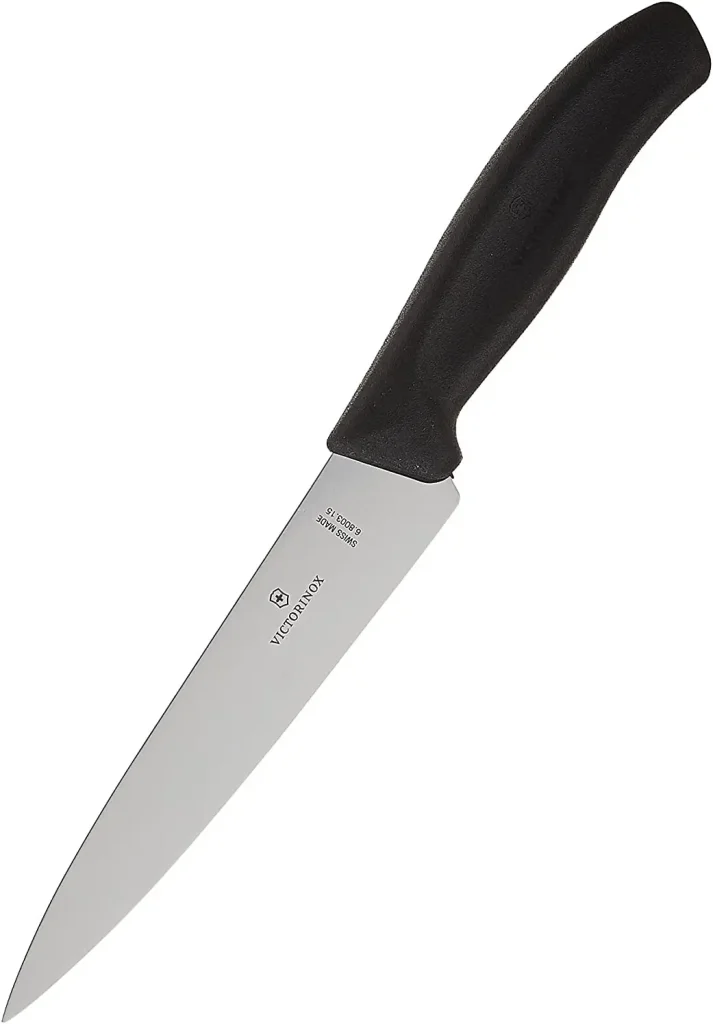
Another option from Victorinox is the Swiss Classic 8-inch chef knife.
It shares some practical qualities with the Fibrox Pro, but the two knives have differences worth considering. The Swiss Classic features a lightweight design, an ergonomic synthetic handle, and a straight stainless steel blade.
Victorinox lists this model at approximately 5.6 ounces, compared with 6.4 ounces for the Fibrox Pro discussed above.
That difference may appeal to someone who prefers a lighter knife. However, weight alone doesn’t determine comfort. Handle shape, balance, and the way the knife sits in your hand also matter.
Its approximately 7.9-inch blade provides plenty of cutting length for common preparation tasks such as chopping vegetables, slicing fruit, mincing herbs, and preparing meat.
What makes it worth considering:
- Lightweight construction.
- Approximately 7.9-inch blade.
- Ergonomic TPE handle.
- Straight stainless steel edge.
- Swiss-made construction.
Where it may fall short:
A lightweight feel won’t suit everyone. Some cooks prefer a more substantial knife, and the 8-inch blade may still feel too long if you usually work with compact kitchen tools.
Who should consider it?
Home cooks who prefer a lightweight, uncomplicated knife for everyday food preparation.
Our verdict: The Swiss Classic is worth comparing with the Fibrox Pro if weight is high on your priority list. If possible, try both handles before deciding.
Fibrox Pro vs. Swiss Classic: Which Victorinox Should You Choose?
Because both knives come from Victorinox and have similar blade lengths, it’s reasonable to wonder whether there’s much difference between them.
The main distinctions are their overall design, listed weight, and handling characteristics.
| Feature | Fibrox Pro | Swiss Classic |
|---|---|---|
| Blade length | Approx. 7.9 inches | Approx. 7.9 inches |
| Listed weight | 6.4 oz | 5.6 oz |
| Handle material | TPE | TPE |
| Construction | Stamped | Stamped |
| Main distinction | Wider blade and textured grip design | Lower listed weight |
The Fibrox Pro is worth considering if you prefer its wider blade and textured handle. The Swiss Classic may be more appealing if you want a lighter overall knife.
Neither is automatically the better choice. If possible, compare how the handles feel in your hand rather than relying on the specifications alone.
What to Look for When Buying Your First Chef Knife?
Now that you’ve seen four options, it’s worth taking a closer look at the features that influence everyday use.
A familiar brand name doesn’t guarantee that a knife will suit your kitchen. Blade length, handle dimensions, weight, balance, and maintenance requirements all deserve attention.
Blade Length: Is 6 Inches or 8 Inches Better?
Blade length is one of the first decisions you’ll face.
A 6-inch chef knife is compact and may feel easier to manage if you’re used to smaller kitchen tools. It’s useful for preparing fruit, chopping smaller vegetables, mincing herbs, and handling moderate portions.
An 8-inch chef knife offers more cutting surface. This can make it a versatile choice for larger vegetables, meat, and general household preparation.
Here’s a simple comparison:
| Feature | 6-Inch Chef Knife | 8-Inch Chef Knife |
|---|---|---|
| Overall feel | More compact | Larger |
| Cutting surface | Shorter | Longer |
| Smaller ingredients | Very suitable | Very suitable |
| Larger ingredients | More limited | More versatile |
| Storage | Usually easier | Requires more room |
If you’re looking for one knife to handle a wide variety of kitchen tasks, an 8-inch model is a sensible starting point for many home cooks.
But don’t force yourself to use a larger blade if a 6-inch knife feels more natural. Comfort and control matter more than following a standard size.
Understanding Blade Steel and Edge Retention
Steel affects how a knife performs, how well it resists corrosion, and how easily it can be sharpened.
When comparing knives, you’ll often see terms such as high-carbon stainless steel, hardness, and edge retention. These details are useful, but they shouldn’t be the only things guiding your purchase.
In general, harder steel can retain an edge longer in some designs, but it may be more demanding to sharpen and less forgiving of misuse. Softer steel may need more frequent sharpening, although it can be easier to maintain.
The manufacturer’s heat treatment and blade geometry matter too. Two knives made from broadly similar steel can perform differently because of how their blades are designed and finished.
For your first knife, a reputable stainless steel model with a conventional edge is a sensible place to start. You can explore specialized steels and blade designs later if your cooking needs change.
Handle Shape and Grip
A knife should feel natural in your hand. You shouldn’t have to keep adjusting your grip to make it comfortable.
Some handles are rounded and relatively thick, while others are slimmer or have more noticeable contours.
Before buying, pay attention to:
- Handle thickness and length.
- Surface texture.
- Finger clearance.
- Overall balance.
- Comfort with your preferred grip.
This is particularly important if you have smaller hands. A handle that feels secure to one person may feel too bulky to another.
Weight and Balance
A lightweight knife can feel quick and responsive, while a heavier model may offer a more substantial feel.
There isn’t one ideal weight for every beginner. What matters is whether you can guide the knife comfortably and maintain a relaxed grip.
If possible, hold a few models before buying. Notice how the handle sits in your hand, how the blade moves, and whether the knife feels balanced during a basic cutting motion.
Don’t choose a knife simply because its weight looks impressive on a specification sheet.
Choose a Chef Knife That Fits Your Kitchen and Needs
The right knife depends on more than your cooking experience.
Your hand size, kitchen layout, storage options, and willingness to maintain the blade can all influence which model makes sense.
That’s why we’ve prepared separate buying guides for three common situations. If one of these sounds familiar, take a look before making your final decision.
Best Chef Knife for Small Hands
A standard 8-inch chef knife isn’t comfortable for everyone. If you have smaller hands, a bulky handle or unnecessarily long blade may make everyday preparation more difficult.
Look for a handle that fits naturally and allows you to maintain a relaxed grip.
A 6-inch chef knife may be worth considering, but blade length isn’t the only factor. Handle thickness, weight, and balance can make an equally important difference.
Read our detailed guide: Best Chef Knife for Small Hands
Best Chef Knife for Small Kitchens
A compact kitchen comes with its own challenges. You may have limited counter space, a smaller cutting board, and very little room for traditional knife storage.
Choosing a knife in this situation is partly about finding a practical size and partly about deciding where you’ll keep it.
A blade guard, drawer organizer, or properly installed magnetic strip can help keep your knife accessible without taking up unnecessary counter space.
Read our detailed guide: Best Chef Knife for Small Kitchens
Best Chef Knife for Easy Sharpening
A sharp knife makes everyday preparation easier, but sharpening can feel intimidating when you’re just starting out.
Different steels and blade geometries have different maintenance requirements. Some knives are more forgiving to sharpen, while others benefit from greater attention to sharpening angles and technique.
If you prefer a straightforward maintenance routine, consider a conventional stainless steel chef knife with a standard edge and accessible sharpening support.
Read our detailed guide: Best Chef Knife for Easy Sharpening
German vs. Japanese Chef Knives for Beginners
If you’ve spent time shopping for chef knives, you’ve probably noticed how often German and Japanese knives are compared.
Both styles have excellent options, and neither is automatically better for a beginner. Their differences generally relate to blade design, cutting feel, and maintenance.
Traditional German-style chef knives often have a more substantial feel and a curved blade profile that supports a rocking cutting motion.
Japanese-style knives often feature thinner blade geometry and are designed with precise cutting in mind. Some use harder steels and thinner edges, which can provide excellent cutting performance but may require more careful handling.
Here’s a general comparison:
| Feature | German-Style Knives | Japanese-Style Knives |
|---|---|---|
| Typical feel | Often heavier | Often lighter |
| Blade profile | Frequently more curved | Often flatter |
| Edge design | Commonly more robust | Often thinner |
| Steel | Many stainless options | Stainless and carbon options |
| Maintenance | Depends on model | Depends on model |
| Typical focus | Versatile everyday use | Precise cutting |
These are general tendencies, not strict rules. Modern manufacturers produce many knives that don’t fit neatly into either category.
For your first purchase, don’t choose a style simply because it sounds more professional. Think about how you prepare food, how much maintenance you’re comfortable with, and which knife feels better in your hand.
How Much Should a Beginner Spend on a Chef Knife?
It’s tempting to assume that a more expensive knife will automatically perform better. In reality, the relationship between price and everyday usefulness isn’t always that simple.
A well-made entry-level knife can handle most home cooking tasks. Spending more may get you different materials, refined construction, better finishing, or a design that better suits your preferences.
But those upgrades aren’t essential for everyone.
Before purchasing, ask yourself a few questions.
How often will you use it?
If you prepare meals every day, investing in a dependable knife makes sense. If you cook occasionally, an affordable model may be perfectly adequate.
Does it feel comfortable?
A reasonably priced knife that fits your hand is often a better purchase than an expensive model that feels awkward.
Can you maintain it?
Consider the cost of sharpening equipment or professional sharpening services, along with suitable storage.
Are you paying for features you actually need?
Premium finishes, unusual materials, and decorative handles can look attractive, but they don’t necessarily improve everyday cooking.
My advice is to set a budget you’re comfortable with, compare a few reputable models, and choose based on practical features rather than price alone.
How to Maintain Your First Chef Knife?
Buying a good knife is only half the job. Taking care of it will help preserve its edge, appearance, and usefulness over time.
Fortunately, you don’t need an elaborate maintenance routine. A few simple habits are usually enough.
Wash and Dry It After Use
Clean your knife with warm water and mild dish soap after preparing food. Dry it with a clean towel before storing it.
Avoid leaving it in a sink full of water or allowing food residue to remain on the blade for long periods.
Even stainless steel can develop staining or corrosion under unsuitable conditions.
Choose the Right Cutting Board
Your cutting board has a direct effect on how quickly a knife becomes dull.
Wood and suitable plastic cutting boards are generally sensible choices. Avoid cutting directly on glass, stone, ceramic, or metal surfaces because they can damage the edge.
If you want your knife to retain its cutting performance for longer, choosing the right cutting surface is a simple habit worth developing.
Store It Safely
Never throw a sharp chef knife loosely into a crowded kitchen drawer.
Apart from creating a risk of accidental cuts, contact with other utensils can damage the blade.
Consider using:
- A protective blade guard.
- A dedicated drawer organizer.
- A traditional knife block.
- A properly installed magnetic knife strip.
Choose a storage method that suits your available space and keeps the blade protected.
Understand Honing vs. Sharpening
These two terms are often used interchangeably, but they describe different maintenance tasks.
Honing helps realign the cutting edge. Sharpening removes a small amount of material to create a fresh edge.
How frequently you need to sharpen your knife depends on how often you use it, the steel, your cutting surface, and your maintenance habits.
You don’t need to sharpen a new knife immediately. Pay attention to its cutting performance and follow the manufacturer’s recommendations.
Common Mistakes Beginners Should Avoid
Even a relatively simple knife purchase can go wrong if you focus on the wrong things.
Here are some common mistakes worth avoiding.
Buying the Most Expensive Knife You Can Afford
A premium knife isn’t automatically the best choice for someone learning to cook. You may end up paying for materials or features that make little difference to everyday preparation.
Start with a practical model and upgrade later if your needs change.
Choosing a Blade That’s Too Large
An extra-long blade may look impressive, but that doesn’t mean it’s comfortable for your kitchen.
Consider your hand size, cutting board, storage space, and typical ingredients before choosing an 8-inch or 10-inch model.
Ignoring Handle Comfort
This is one of the easiest mistakes to make when shopping online.
People often compare steel grades and blade construction while overlooking the part of the knife they actually hold.
Pay attention to handle dimensions and grip feedback before purchasing.
Expecting a Knife to Stay Sharp Forever
Every knife loses cutting performance with use. Even high-quality blades need periodic sharpening.
Don’t assume that paying more means you’ll never need to maintain the edge.
Using the Wrong Cutting Surface
Glass and stone boards may look attractive, but they are poor choices for maintaining a sharp knife.
Choose a suitable wooden or plastic cutting board instead.
Putting Your Knife in the Dishwasher
Hand washing and immediate drying are generally sensible ways to protect a chef knife.
Dishwasher use can expose a knife to high temperatures, harsh detergents, and contact with other utensils. Always follow the manufacturer’s care instructions for your particular model.
Frequently Asked Questions
What is the best chef knife for a beginner?
A practical stainless steel chef knife with a comfortable handle and manageable blade length is a good starting point. The Victorinox Fibrox Pro and Mercer Culinary Millennia are two models worth comparing because they focus on everyday usability.
Should beginners buy a 6-inch or 8-inch chef knife?
A 6-inch knife can feel more manageable for people who prefer smaller tools or have limited cutting space. An 8-inch chef knife offers more cutting length and versatility for general food preparation. Choose the size that feels comfortable rather than automatically following the standard.
Are expensive chef knives worth buying for beginners?
Not necessarily. Expensive knives may offer premium steel, refined construction, or specialized designs, but a well-made entry-level knife can handle most home cooking tasks. Comfort and maintenance are more important than price alone.
Is stainless steel better for a beginner chef knife?
Stainless steel is often a practical choice because it generally offers good corrosion resistance and straightforward care. However, performance depends on the specific steel, heat treatment, and blade design.
Final Thoughts: Start With a Knife That Feels Right
Choosing your first chef knife doesn’t have to be complicated. You don’t need the most expensive model, the hardest steel, or a knife used by professional chefs to prepare good food at home.
Start with the basics: a comfortable handle, a suitable blade length, dependable steel, and a design you can maintain without difficulty.
The Victorinox Fibrox Pro is a practical starting point if you value a textured grip and an everyday full-size design. The Mercer Millennia is worth comparing if you want useful handling features at a value-focused price. The WÜSTHOF Gourmet offers a German-made alternative, while the Victorinox Swiss Classic deserves consideration if you prefer a lighter knife.
The Best Chef Knife for Beginners is ultimately the one that suits your hands, cooking habits, and budget. A knife that feels comfortable and is easy to maintain is more useful than one that simply looks impressive in a product photograph.
If you have smaller hands, limited counter space, or want a knife that’s easier to sharpen, explore our dedicated guides before making your final decision:
- Best Chef Knife for Small Hands
- Best Chef Knife for Small Kitchens
- Best Chef Knife for Easy Sharpening
A good first chef knife should make cooking feel more comfortable, not more complicated. Choose one that suits your needs, learn how to care for it, and you’ll have a dependable tool for everyday meals.
Affiliate Disclosure
This article contains affiliate links. If you purchase a product through one of these links, we may earn a commission at no additional cost to you. Our recommendations are based on product research and published specifications. Affiliate relationships do not determine our product assessments.