Best Chef Knife for Professionals: Top 6 Picks
Picture hour nine of a Saturday double. The board is crowded, the tickets keep printing, and the knife in your hand either feels like part of you or like a brick. That is the real test of the best chef knife for professionals. It isn’t how sharp it is out of the box. It’s whether it still feels good at the end of the shift, goes back to sharp in a minute, and doesn’t hurt to replace when it goes missing.
This guide covers six knives that earn a spot on a working board: what each one is like to use, the specs that matter, and who should skip it. Cooking at home rather than for a living? Our guide to the best chef knife for home use fits that better.
Key Takeaways
- Safest buy for most working cooks: Victorinox Fibrox Pro. It’s inexpensive, light, easy to sharpen and NSF certified.
- Heavy prep: Wüsthof Classic or Zwilling Pro. Both are forged, weigh about 265 g and forgive rough handling.
- Long shifts and slicing: Mac MTH-80, Misono UX10 or Global G-2. All three are light, and the Mac and Misono are harder, longer-lasting steels.
- Rule of thumb: If you rarely have time to sharpen, choose softer, tougher steel. If you sharpen regularly, harder steel pays off.
Quick Picks
| Best for | Knife | Style | Price tier* | Link |
|---|---|---|---|---|
| Best value workhorse | Victorinox Fibrox Pro 8″ | Swiss, stamped | $ | Check Price |
| Best for heavy prep | Wüsthof Classic 8″ | German, forged | $$$ | Check Price |
| Best for long shifts | Mac Professional MTH-80 | Japanese, bolstered | $$ | Check Price |
| Best Japanese gyuto | Misono UX10 Gyuto 210 mm | Japanese, stainless | $$ | Check Price |
| Best for sanitation | Global G-2 8″ | Japanese, all-stainless | $$ | Check Price |
| Best German alternative | Zwilling Pro 8″ | German, forged | to $ | Check Price |
*Rough US street prices that change often: $ is under about $75, $$ is about $75 to $160, $$$ is above about $160. Check the retailer page for the current price.
Find Your Chef Knife in 30 Seconds
Skip the spec sheets and start here.
| If this sounds like you… | Choose |
|---|---|
| “I need something reliable that won’t wreck my budget if it disappears.” | Victorinox Fibrox Pro |
| “I break down a lot of product and want a knife that can take it.” | Wüsthof Classic |
| “I want it light, sharp and balanced, but not fragile.” | Mac MTH-80 |
| “I slice all day and I’m happy to use a stone.” | Misono UX10 |
| “I want a light, seamless knife that’s easy to keep clean.” | Global G-2 |
| “I like German weight, but a full bolster gets in my way.” | Zwilling Pro |
Best for a specific job:
- Line cooks: Victorinox Fibrox Pro. Cheap enough to replace and fast to sharpen.
- Culinary students: Victorinox Fibrox Pro first. Move up once you know how you hold a knife.
- Prep cooks and butchery-heavy work: Wüsthof Classic or Zwilling Pro.
- Slicing and fine knife work: Mac MTH-80 or Misono UX10.
What Actually Matters in a Professional Chef Knife
Forget the marketing. When knife use is your job, six things decide whether a knife is right:
- Comfort at hour ten. Weight, balance and handle shape decide how your wrist feels, and a knife that feels great for ten minutes can wear on you over ten hours.
- Edge retention versus ease of sharpening. Harder steel stays sharp longer but chips more easily and takes more skill on the stone. Softer steel dulls sooner but is tough and quick to touch up.
- Toughness. Pro knives get dropped, stacked, scraped and used on things they shouldn’t be.
- Hygiene. Victorinox lists its Fibrox knives as NSF certified. We found no NSF listings for the other five, so if your employer or health authority requires certified equipment, check before you buy.
- Cost of ownership. Knives get lost and borrowed. Price and warranty matter more than they do at home.
- Availability. You want to be able to buy the same knife again in five years.
- Sharpener. You need to have the best knife sharpener for these amazing chef knifes.
This guide is a research-based comparison built on manufacturer specs, retailer listings and verified owner feedback. It isn’t a hands-on test, and we link to each maker’s own page so you can confirm details before you buy.
Side-by-Side Specs
| Victorinox Fibrox Pro | Wüsthof Classic | Mac MTH-80 | Misono UX10 | Global G-2 | Zwilling Pro | |
|---|---|---|---|---|---|---|
| Blade length | 200 mm (8″) | 200 mm (8″) | 200 mm (8″) | 210 mm (8.2″) | 200 mm (8″) | 200 mm (8″) |
| Weight | about 184 g | about 265 g | about 192 g | about 159 g | about 170 g (6 oz) | about 266 g |
| Steel | High-carbon stainless (stamped) | X50CrMoV15 (forged) | Molybdenum-vanadium | Swedish stain-resistant steel | Cromova 18 | Friodur, ice-hardened (forged) |
| Hardness (HRC) | Not published | 58 | 61 | 60 | 56 to 58 | 57 |
| Edge | Not published | about 14° per side | 15° per side | 70/30 asymmetrical bevel | about 10° to 15° | about 15° per side |
| Handle | Textured TPE | Riveted POM | Riveted Pakkawood, bolster | Composite wood | All stainless, dimpled | Triple-riveted resin, half bolster |
| Made in | Switzerland | Germany | Japan | Japan | Japan | Germany |
| Care level | Low | Low to medium | Medium | Medium | Medium | Low to medium |
| Price tier | $ | $$$ | $$ | $$ | $$ | to $ |
Weights vary slightly between retailer listings and production runs, so they’re approximate. Care level is our own editorial rating based on steel hardness and typical owner feedback.
The 6 Best Chef Knives for Professionals
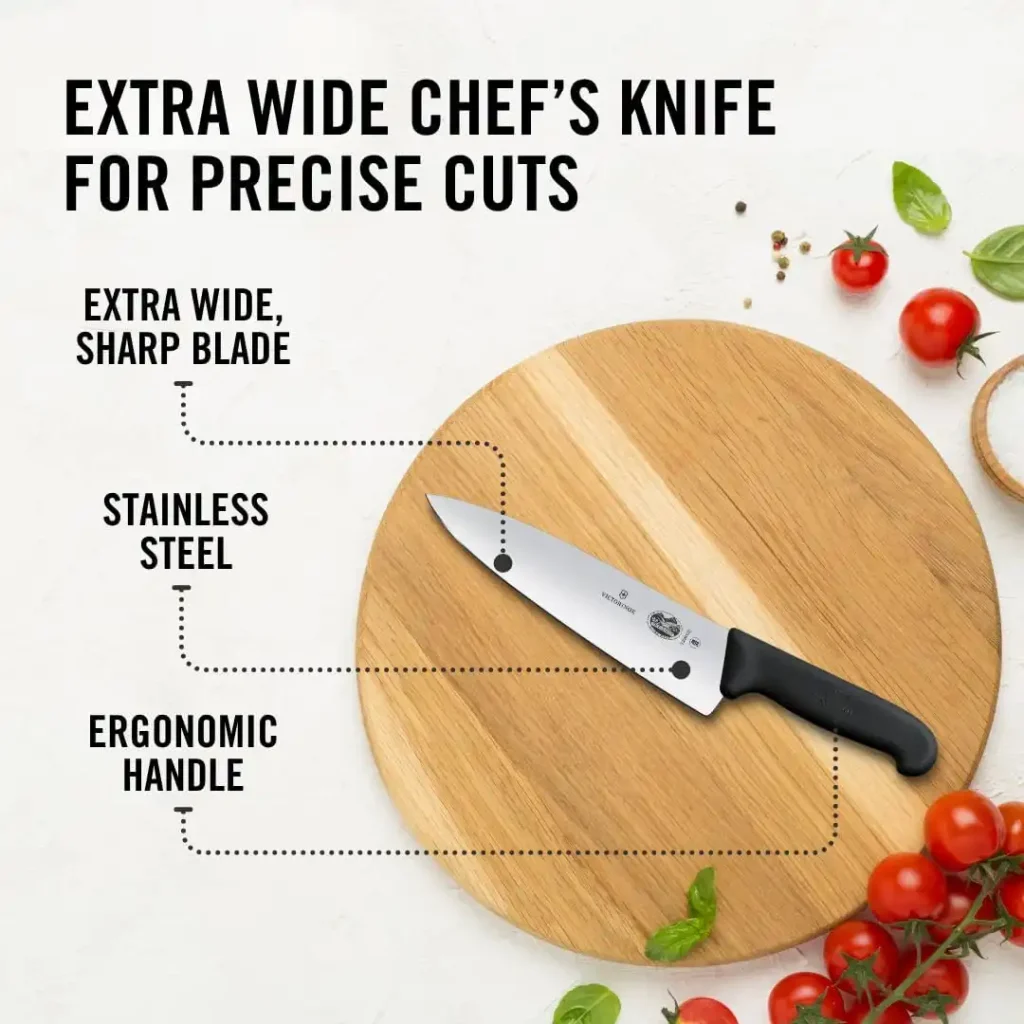
1. Victorinox Fibrox Pro 8″: Best Value Workhorse
Best for: Line cooks, culinary students and anyone who wants a dependable knife they won’t mind replacing.
Key specs: Stamped high-carbon stainless blade, textured Fibrox (TPE) handle, about 184 g, made in Switzerland, NSF certified, lifetime warranty against defects. Victorinox doesn’t publish a hardness figure.
What it’s like: Light, plain and quietly capable. This is the knife foodservice suppliers sell in bulk, often with colour-coded handles, and it earns that spot. The blade takes a good edge and goes back to sharp quickly on a stone or steel, and the textured handle stays grippy when your hands are wet or greasy, which is exactly when it matters.
Pros
- Performs well above its price
- Light enough for a full shift
- Slip-resistant handle and NSF certification
- Easy to sharpen, which suits a busy kitchen
Cons
- Plain looks and a plastic handle
- No bolster, so it balances differently from forged German knives
- Edge retention is good, not exceptional
Skip it if: You want a heavier, forged feel, or a knife that doubles as a showpiece.
Verdict: The safest first buy for professionals, and a sensible spare even if you own something fancier.
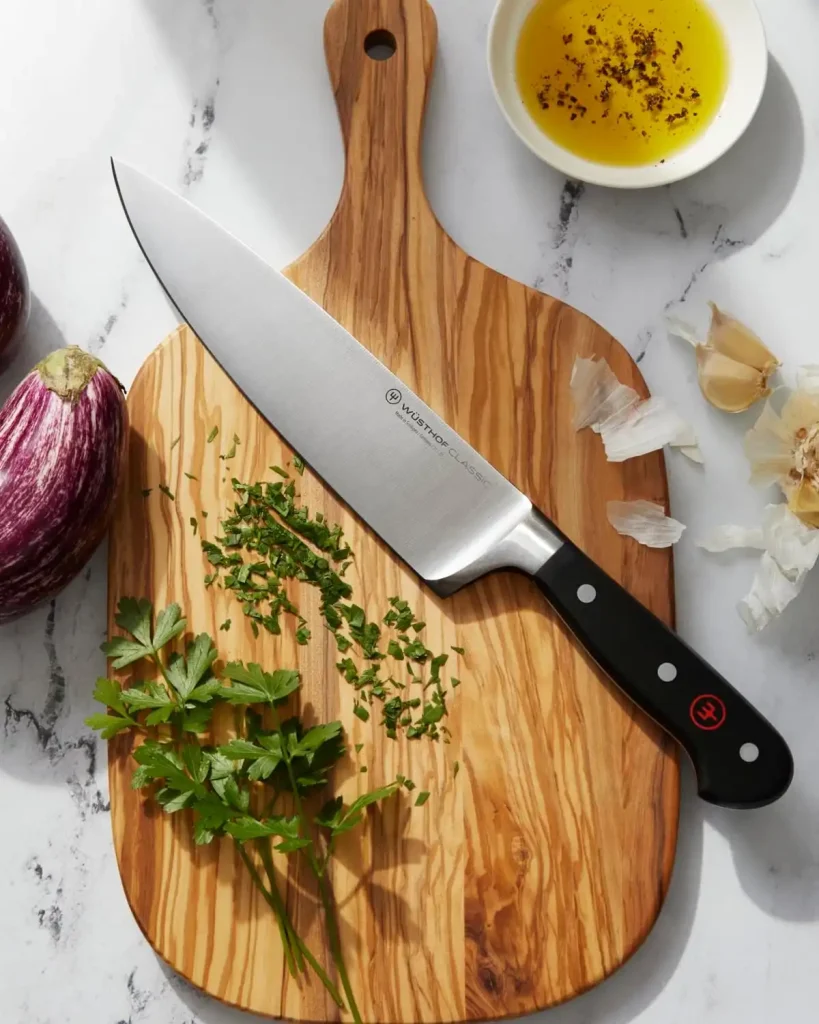
2. Wüsthof Classic 8″: Best for Heavy Prep
Best for: Cooks who break down a lot of product and want one knife that lasts a career.
Key specs: Fully forged from X50CrMoV15 steel, 58 HRC, about 14° edge angle per side, full bolster, triple-riveted POM handle, about 265 g, made in Solingen, Germany, lifetime warranty. A 10″ version is also available at 58 HRC.
What it’s like: Solid. The weight does a lot of the work on dense produce and chicken joints, and the full bolster protects your fingers and moves the balance toward the heel. The steel is on the softer side next to Japanese options, so it dulls sooner, but a few passes on a honing steel bring it back without fuss.
Pros
- Tough, forgiving edge that tolerates hard use
- Confident weight for heavy prep
- Lifetime warranty and a long track record
- Easy to hone and sharpen
Cons
- One of the two heaviest knives here
- Costs noticeably more than the Victorinox
- Dulls sooner than harder Japanese steels
Skip it if: You prefer a light blade for delicate slicing, or you’re spending under about $100.
Verdict: A durable heavyweight for cooks who like to feel the knife working.
3. Mac Professional MTH-80: Best for Long Shifts
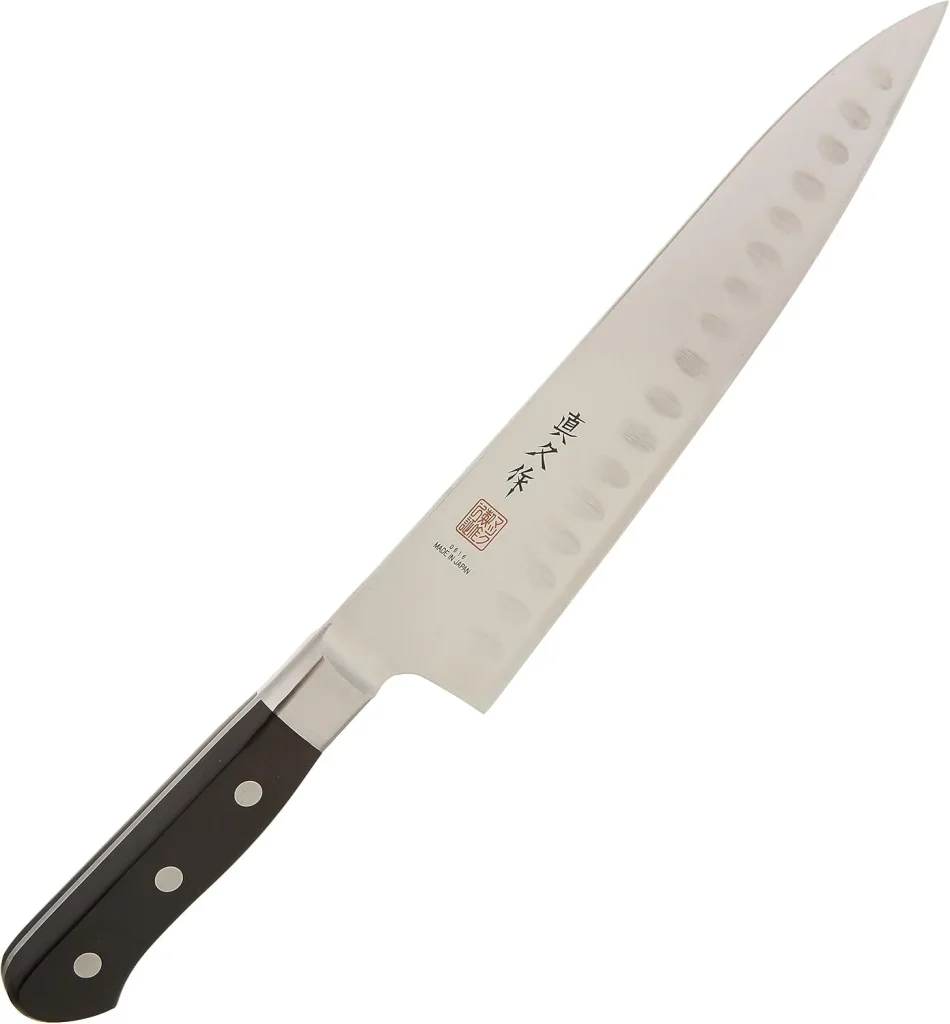
Best for: Cooks who want a light, sharp knife that stays comfortable across a long service without being fragile.
Key specs: Molybdenum-vanadium steel, 61 HRC, 15° edge angle per side, hollow-edge dimples, riveted Pakkawood handle with bolster, about 192 g (6.8 oz), made in Japan, 25-year warranty.
What it’s like: Thin, light and well balanced. The bolster keeps the knife from feeling tip-heavy, and the hollow-edge dimples help food release when you’re working through potatoes, squash or apples at speed. It sits between German and Japanese design, so it’s an easy step for cooks used to Western knives.
Pros
- Very sharp out of the box
- Light weight cuts fatigue over a long shift
- Hollow edge helps with sticky produce
- 25-year warranty
Cons
- Thin blade needs care around bones, frozen food and hard squash
- Harder steel is less forgiving of twisting or prying
- Costs more than the Victorinox
Skip it if: You regularly cut through bones or frozen product, or you want a heavy knife.
Verdict: A strong choice if your day is mostly slicing and dicing and you want a lightweight knife with a bolster.
4. Misono UX10 Gyuto 210 mm: Best Japanese Stainless Gyuto
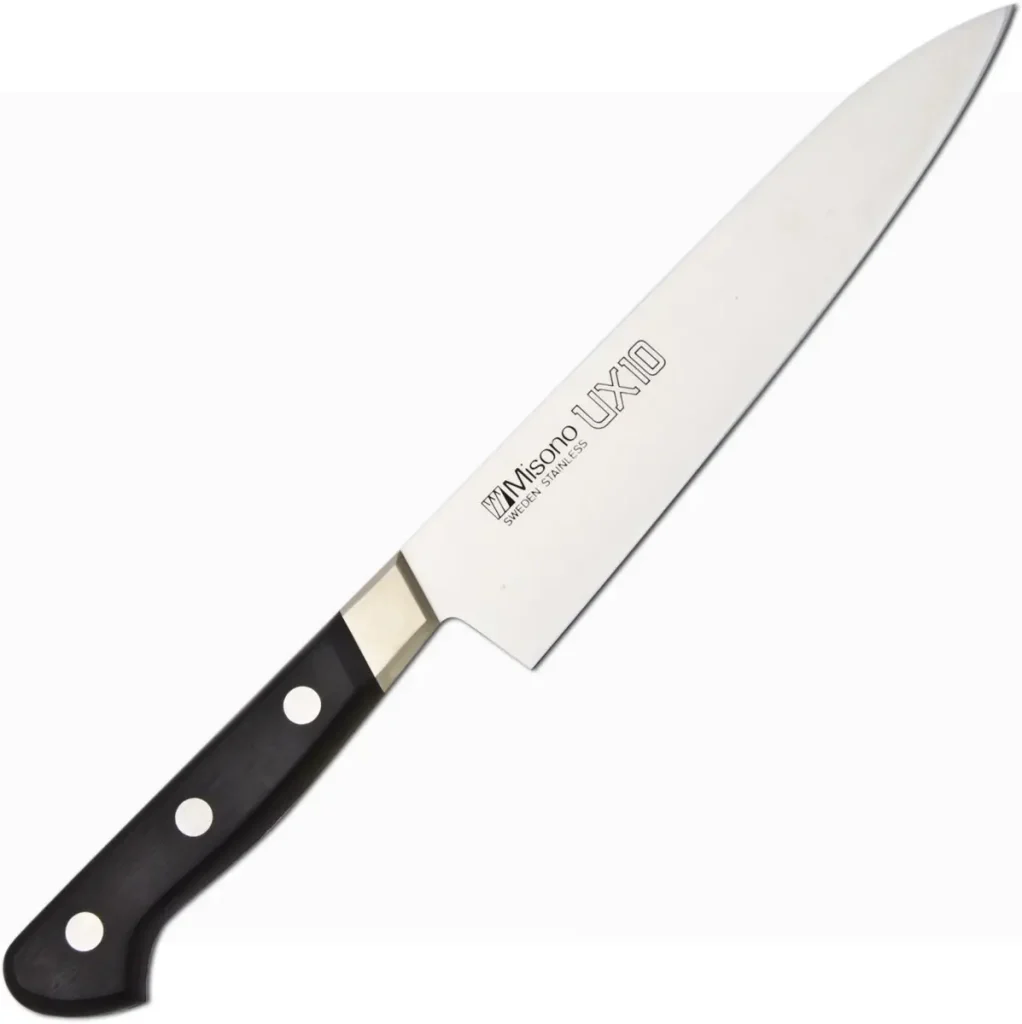
Best for: Cooks who value edge retention and fine slicing and are comfortable maintaining a harder blade.
Key specs: 210 mm (8.2″) blade, Swedish stain-resistant steel, about 60 HRC, about 159 g, composite wood handle, listed with a 70/30 asymmetrical bevel, made in Japan. This blade is slightly longer than the 8″ (200 mm) knives in this guide.
What it’s like: The lightest knife here, with a thin blade built for slicing. The retailer describes it as hand-finished with the longest edge retention in the Misono range. The asymmetrical bevel means the edge is ground slightly off-centre, which changes how it cuts and how it should be sharpened. Korin lists a left-hand conversion for an extra charge.
Pros
- Very light, which helps over long shifts
- Hard steel with strong edge retention
- Thin, precise blade for slicing and fine work
- Stainless, so it’s forgiving about moisture
Cons
- The asymmetrical edge needs care when sharpening
- Hard, thin steel can chip if twisted or used on bones
- Costs more than the Victorinox
- Retailer care information is inconsistent, so treat hand washing as the safe default
Skip it if: You want a heavy, tough knife, or you share your knife with people who are rough on blades.
Verdict: A refined, lightweight option for cooks who already know their way around a whetstone.
5. Global G-2 8″: Best for Sanitation and a Light Build
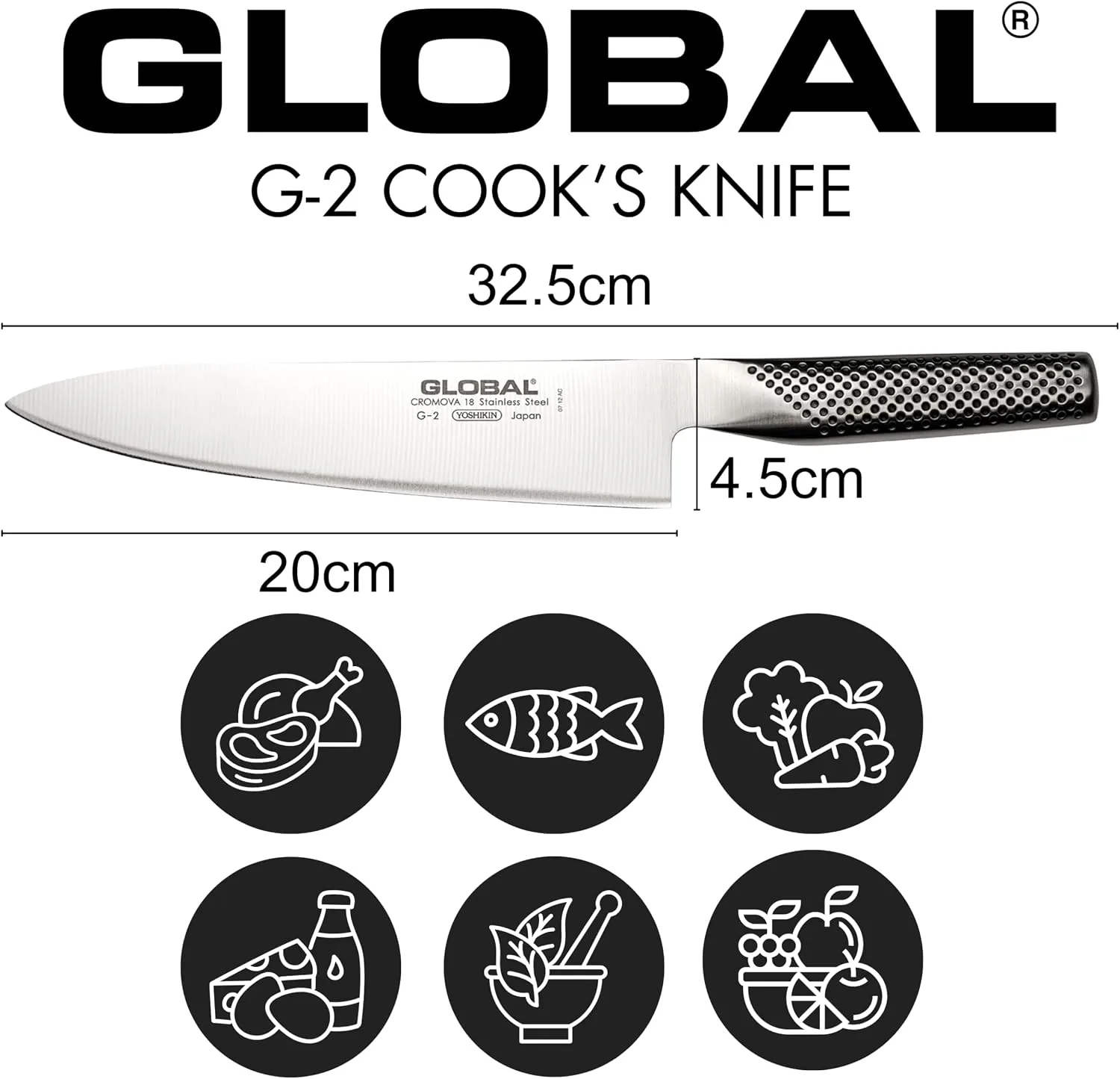
Best for: Cooks who like a very light knife and want a handle with no rivets or gaps.
Key specs: Cromova 18 high-carbon stainless steel, 56 to 58 HRC, edge angle of about 10° to 15° with a double bevel, all-stainless handle with a dimpled, non-slip texture (filled with sand to adjust balance), about 6 oz (170 g), made in Japan.
What it’s like: Different from everything else on this list: a single stainless profile with a dimpled handle and no rivets. That leaves no seams for food to work into, which is its main appeal in a kitchen that cares about sanitation. It’s light with a fine edge, and the moderately hard steel is easier to keep sharp than the very hard Japanese options.
Pros
- Very light
- All-stainless build with no rivets or gaps
- Sharp, fine edge that’s manageable to maintain
- Distinctive look
Cons
- The handle shape and light feel are polarizing, so many cooks prefer to hold one first
- Some cooks find a smooth-sided metal handle slick when their hands are greasy, despite the dimples
- Too little knife for some people on heavy prep
Skip it if: You like a forged, bolstered feel or prefer a heavy blade.
Verdict: Worth trying if you like light knives and a hygienic design, as long as the handle suits your grip.
6. Zwilling Pro 8″: Best German Alternative
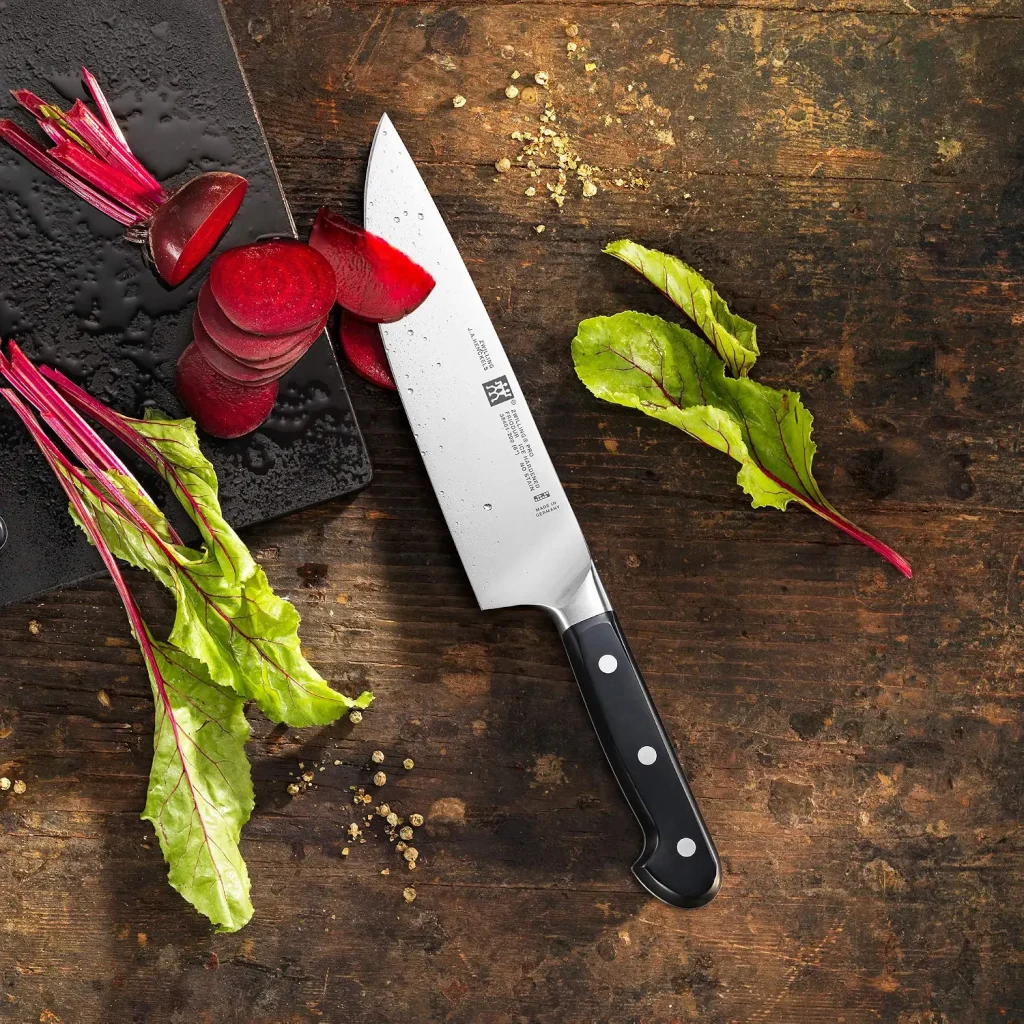
Best for: Cooks who like German weight and toughness but want something other than a full bolster.
Key specs: Friodur ice-hardened high-carbon stainless steel, forged from a single piece, 57 HRC, about 15° edge angle per side, curved half bolster, full tang, triple-riveted resin handle, about 266 g, made in Germany, lifetime warranty.
What it’s like: A heavy, forged workhorse in the same camp as the Wüsthof. The curved half bolster is designed to support a pinch grip and leave the whole edge exposed for sharpening, which many cooks find more comfortable than a full bolster. It has the softest steel in this guide, so expect to hone it often, but it’s tough and forgiving.
Pros
- Forged, full-tang construction that takes hard use
- Half bolster designed for a pinch grip and full-length sharpening
- Lifetime warranty
- Tough, forgiving steel
Cons
- Heavy, at about the same weight as the Wüsthof
- Softest steel of the six, so it needs regular honing
- Priced above the Victorinox
Skip it if: You want a light knife or the hardest, longest-lasting edge.
Verdict: A solid German choice if you want forged construction but prefer a half bolster.
How to Choose a Professional Chef Knife?
8 inch or 10 inch?
Eight inches (about 200 mm) is the standard and is easier to control on a crowded board. Ten inches covers more food per stroke and suits high-volume prep on a roomy bench, but it’s heavier and less agile in tight spaces. Some cooks keep both sizes.
Hard steel or tough steel?
Hardness is measured on the Rockwell (HRC) scale. In this guide it runs from about 56 (Global) to about 61 (Mac). Harder steel holds an edge longer but chips more easily and takes more skill on the stone. Softer steel dulls sooner but is tough and quick to touch up on a honing steel.
A simple way to decide: if you rarely get time to sharpen, go softer and tougher. If you sharpen regularly and care about precision, go harder.
Forged or stamped?
Forged knives (Wüsthof, Zwilling) are heavier, with a bolster and full tang. Stamped knives (Victorinox) are lighter and cheaper. Neither is automatically better, and over a long shift lighter often wins.
Handle and hygiene
Textured synthetic handles (Victorinox) stay grippy when wet. Riveted handles feel solid but have joins. All-stainless handles (Global) have none. Pick what suits your grip and your kitchen’s hygiene rules.
Budget and cost of ownership
- Under about $75: Stamped knives like the Victorinox are excellent value and easy to replace.
- About $75 to $160: The sweet spot for most professionals.
- Above about $160: Premium steel and finish, and worth it if you’ll look after the knife.
The two-knife setup
A common approach is one good personal knife plus a cheap spare for loans, backups and rougher jobs. A Victorinox makes a good spare next to almost anything else on this list.
Keeping a Professional Chef Knife in Working Condition
- Hone often, sharpen on a schedule. Use a rod to realign the edge between services, and sharpen on a stone or through a sharpening service when honing stops working. For harder Japanese steel, a fine ceramic rod is generally safer than a coarse steel.
- Wash and dry as you go. Hand wash and dry right away, and don’t leave the knife in the sink or under other equipment.
- Use the right board. Wood or soft plastic protects the edge. Glass, stone and ceramic dull it.
- Scrape with the spine, not the edge. Flip the knife over.
- Don’t ask a thin blade to do a cleaver’s job. Bones and frozen product chip hard Japanese steel.
- Store it safely. Use a guard, a magnetic strip or a knife roll, not a loose drawer or bag.
- Mark it. In a shared kitchen, a knife with a distinctive handle or a mark of your own is harder to lose.
Four common mistakes
- Buying the hardest steel without the time or skill to sharpen it
- Hunting for the “best” knife and ignoring comfort in your own hand
- Leaving a good knife wet in a sink or a bag
- Using one knife for everything, bones included
Frequently Asked Questions
Final Thoughts
The best chef knife for professionals is the one that’s still comfortable at hour ten, easy to keep sharp, and affordable enough to survive a real kitchen. Fancy steel won’t fix a handle that doesn’t fit your grip.
- Want a dependable, NSF-certified workhorse? Start with the Victorinox Fibrox Pro
- Do heavy prep? Look at the Wüsthof Classic or the Zwilling Pro.
- Prefer light and sharp? Try the Mac MTH-80, Misono UX10 or Global G-2.
Whichever you choose, hone it, dry it and keep it out of the sink, and it will earn its place on your board. Still deciding between two? Compare their weight and hardness in the spec table and go with the one that suits your hand.