Best Chef Knife for Small Hands
Finding the best chef knife that feels comfortable can be difficult when you have smaller hands. A knife that works perfectly well for someone else may feel bulky, awkward, or difficult to control in your grip.
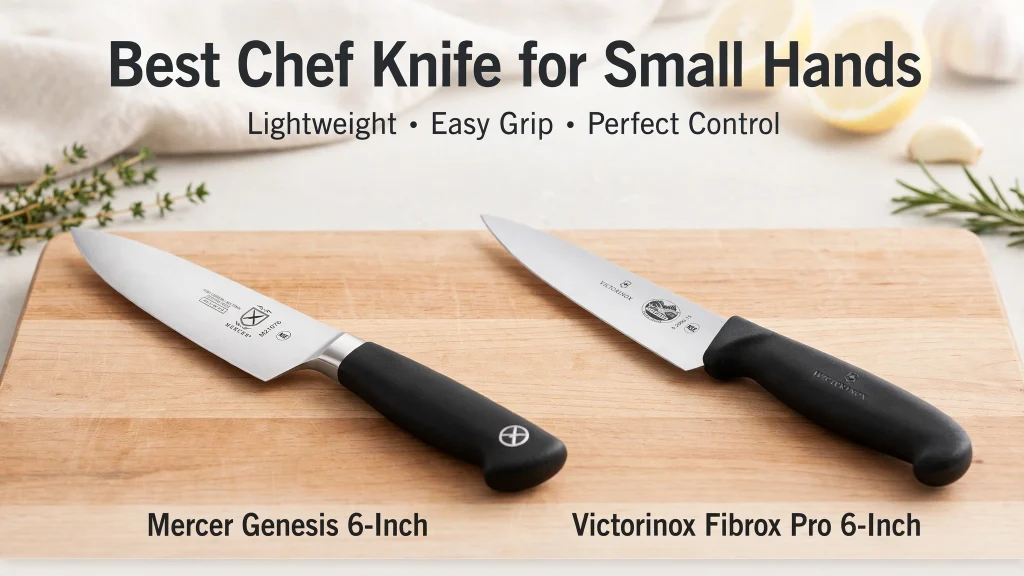
The problem is not necessarily the blade length. Handle thickness, handle shape, knife weight, balance, and the design of the bolster can all affect how comfortably a knife fits your hand.
A full-size 8-inch best chef knife is not automatically unsuitable for someone with smaller hands. However, a shorter 6-inch blade can be easier to manage, particularly if you prefer a lighter knife or have limited cutting-board space.
In this guide, we compare three 6-inch best chef knives with different designs and price positions:
- Victorinox Fibrox Pro 6-inch: A lightweight, practical option for everyday food preparation.
- Mercer Genesis Short Bolster 6-inch: A forged knife with a textured handle and a shortened bolster.
- WÜSTHOF Classic 6-inch Half Bolster: A traditional forged knife with a half-bolster design.
These knives are not guaranteed to fit every smaller hand. Individual comfort depends on hand shape, grip style, and personal preference. The goal is to help you understand their differences and choose a knife worth considering.
Quick Picks: Best Chef Knife for Small Hands
| Knife | Best for | Main advantage | Main compromise |
|---|---|---|---|
| Victorinox Fibrox Pro 6-inch | Lightweight everyday use | Low weight and practical handle | Less substantial feel than heavier forged knives |
| Mercer Genesis Short Bolster 6-inch | Grip and control | Textured handle and shortened bolster | Handle may still feel thick to some users |
| WÜSTHOF Classic 6-inch Half Bolster | Traditional forged construction | Durable construction and half bolster | Heavier feel and higher price position |
Our starting recommendation: Consider the Victorinox if you prefer a lightweight knife, the Mercer if you value a textured handle and shortened bolster, or the WÜSTHOF if you prefer a more substantial forged knife.
Before choosing, check the handle dimensions and return policy whenever possible. A shorter blade alone does not guarantee a better fit.
1. Victorinox Fibrox Pro 6-Inch Chef’s Knife
Best for: Lightweight everyday cutting
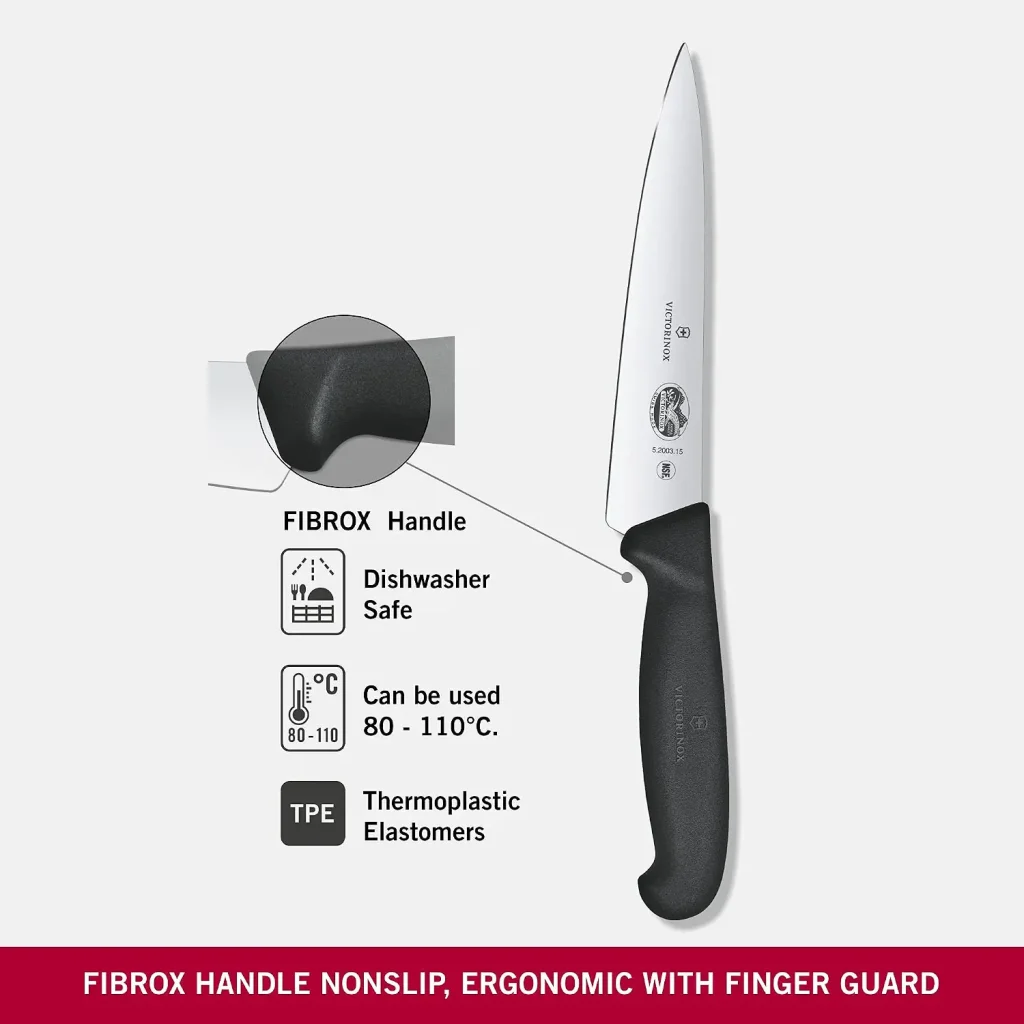
The Victorinox Fibrox Pro 6-inch chef’s knife is a practical option for people who prefer a smaller, lighter kitchen knife. Its compact blade is suitable for everyday preparation tasks such as slicing vegetables, cutting fruit, mincing herbs, and preparing smaller portions of meat.
One of its main advantages is its low weight. Victorinox lists the knife at approximately 2.8 ounces, making it considerably lighter than many traditional forged chef knives.
The handle is made from thermoplastic elastomer (TPE), a material designed to provide a practical, secure grip. However, handle comfort is personal, so it is worth checking the shape and thickness before purchasing.
What makes it worth considering?
The shorter blade can feel easier to manage if you are accustomed to smaller kitchen knives. It also takes up less room on a cutting board, which can be useful in a compact kitchen.
Its lightweight construction may appeal to anyone who dislikes the feeling of a heavy knife during longer preparation sessions.
Another advantage is its straightforward design. This is not a decorative knife intended to be displayed in a kitchen. It is a practical tool designed for regular food preparation.
Where it may fall short
The lighter construction will not appeal to everyone. Some cooks prefer the additional weight and more substantial feel of a forged knife.
Also, although the Fibrox handle has a practical textured surface, that does not mean it will fit every smaller hand. If your main concern is handle thickness rather than blade length, try to inspect the knife in person.
Key specifications
| Feature | Details |
|---|---|
| Blade length | Approximately 5.9 inches |
| Weight | Approximately 2.8 oz |
| Handle material | Thermoplastic elastomer (TPE) |
| Construction | Stamped |
| Best suited for | Lightweight everyday preparation |
Consider it if: You want a compact, lightweight knife for everyday kitchen tasks and do not need a heavy blade.
Think twice if: You prefer a substantial forged knife or need a particularly narrow handle. Confirm the handle dimensions before buying.
2. Mercer Genesis Short Bolster 6-Inch Chef’s Knife
Best for: A textured grip and shortened bolster
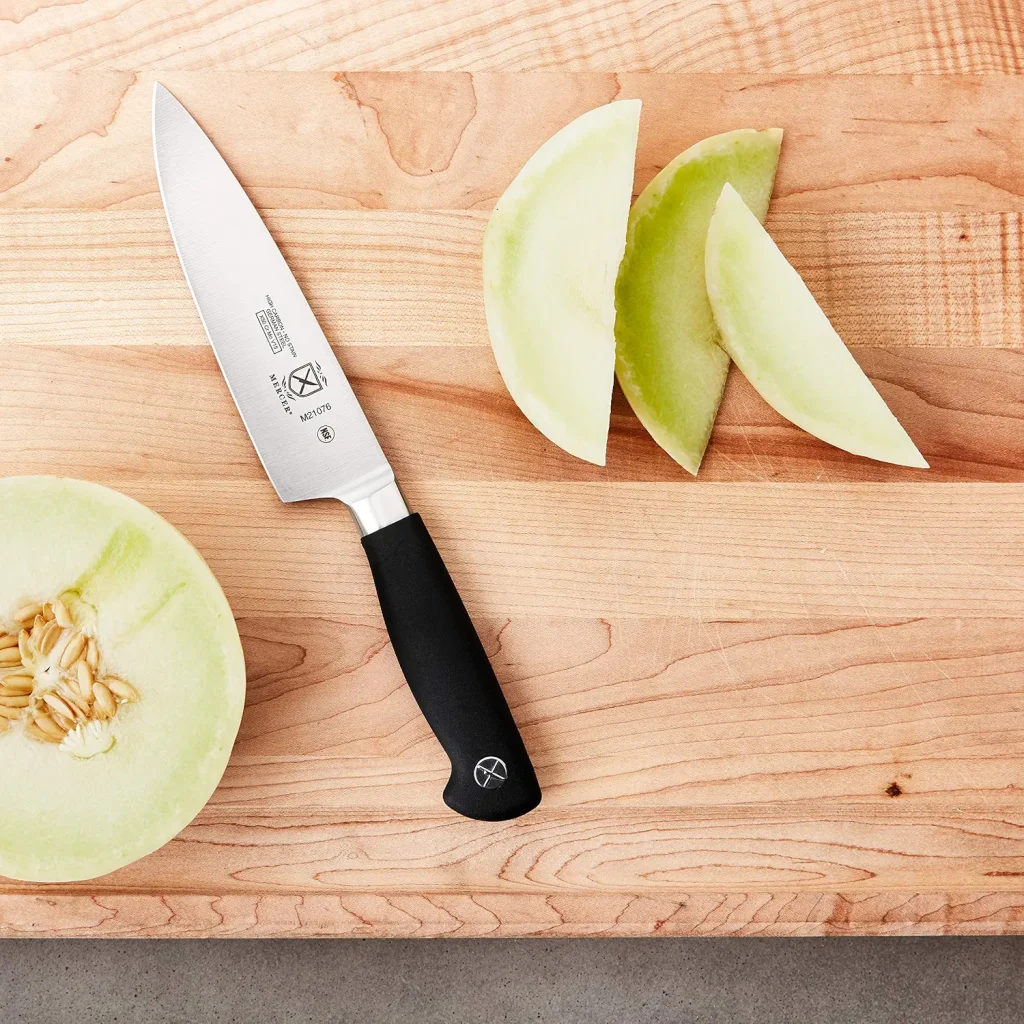
The Mercer Genesis Short Bolster 6-inch chef’s knife offers a different approach from the lightweight Victorinox. It is a forged knife with a Santoprene handle and a shortened bolster design.
The shortened bolster is an important feature to understand. A traditional full bolster can extend down to the cutting edge and may make it harder to sharpen the entire length of the blade. A shortened bolster leaves more of the blade accessible.
For people with smaller hands, the design is worth considering because the bolster shape can influence where your fingers rest and how you hold the knife.
What makes it worth considering?
The handle uses Santoprene, a material known for its soft, textured feel. This may appeal to cooks who prefer a more tactile grip rather than a smooth handle.
Its forged construction also gives it a different feel from the stamped Victorinox. If you prefer a knife with a more substantial build but still want a compact 6-inch blade, the Mercer is worth comparing.
The shortened bolster is another practical advantage. It provides a different grip and sharpening experience from knives with a full bolster.
Where it may fall short
A textured handle does not automatically mean a smaller handle. If your fingers struggle with thick handles, the Mercer may not solve that problem.
Its forged construction also means it will feel different from the lightweight Victorinox. Anyone who prefers an especially light knife should compare their weights before deciding.
Key specifications
| Feature | Details |
|---|---|
| Blade length | 6 inches |
| Handle material | Santoprene |
| Construction | Forged |
| Steel hardness | 56 ± 1 HRC |
| Design | Short bolster |
| Best suited for | Cooks who prefer a textured grip and forged construction |
Consider it if: You want a compact forged knife with a textured handle and shortened bolster.
Think twice if: You specifically need a thin handle or want the lightest possible knife. The published specifications do not establish that its handle is narrower than the alternatives.
3. WÜSTHOF Classic 6-Inch Half Bolster Chef’s Knife

Best for: Traditional forged construction
The WÜSTHOF Classic 6-inch half-bolster chef’s knife is the most traditional option in this comparison. It combines a compact blade with forged construction and a half-bolster design.
WÜSTHOF is known for its German-made kitchen knives, and the Classic range is designed for regular kitchen use. This model may appeal to cooks who prefer a more substantial knife rather than an especially lightweight design.
Its half bolster is also worth noting. Compared with a full bolster, this design leaves more of the blade accessible for sharpening.
What makes it worth considering?
The forged construction gives this knife a more substantial feel than a lightweight stamped knife.
Its 6-inch blade offers a compact alternative to the common 8-inch chef knife. It can be useful for cooks who prefer shorter cutting movements or find longer blades difficult to manage.
The half-bolster design is another practical feature. It allows access to more of the blade edge during sharpening, which can make long-term maintenance more straightforward.
WÜSTHOF lists the blade hardness at 58 HRC, giving buyers a useful specification when comparing it with the Mercer.
Where it may fall short
This knife is not the obvious choice if your main priority is low weight. Its forged construction gives it a more substantial feel, which some cooks appreciate and others may find tiring.
It also costs more than many basic entry-level kitchen knives. If you are buying your first best chef knife, consider whether you will benefit from its construction and whether it feels comfortable enough to justify the extra expense.
The handle is not specifically advertised as a small-hand design. Its 6-inch blade should not be treated as proof that the handle will fit smaller hands.
Key specifications
| Feature | Details |
|---|---|
| Blade length | 6 inches |
| Handle length | Approximately 4.4 inches |
| Construction | Forged |
| Steel hardness | 58 HRC |
| Design | Half bolster |
| Origin | Germany |
| Best suited for | Cooks who prefer traditional forged knives |
Consider it if: You prefer a forged knife with a compact blade and half-bolster design.
Think twice if: You want an especially lightweight knife or are working with a limited budget.
How We Researched These Chef Knives?
Choosing the best chef knife for small hands requires looking beyond the blade length. A compact blade may be easier to control, but the handle, weight, balance, and bolster can have just as much influence on comfort.
For this comparison, we focused on three knives with 6-inch blades and different construction styles.
We reviewed manufacturer specifications, including blade length, construction, handle materials, and published hardness information. We also considered how each design may suit different cooking preferences.
Our comparison focuses on:
- Blade length: Whether a compact blade may be easier to manage during everyday preparation.
- Weight: Whether a lighter or more substantial knife is likely to suit different preferences.
- Handle material: How the handle’s surface and material may affect grip.
- Bolster design: Whether the bolster may affect finger placement and sharpening access.
- Construction: The differences between stamped and forged knives.
This is a specification-based comparison, not a claim of hands-on testing. We have not independently measured every handle’s circumference or tested each knife in users’ hands. Where manufacturers do not publish a dimension, we avoid presenting an estimated measurement as a verified fact.
We recommend checking the manufacturer’s latest specifications and, if possible, handling the knife before purchasing.
What Makes a Chef Knife Comfortable for Small Hands?
A smaller hand does not necessarily need the smallest available knife. The important thing is finding a combination of blade and handle dimensions that feels natural.
Here are the main factors to consider.
1. Handle Thickness and Shape
Handle thickness is one of the most important things to check.
A handle that is too thick may force your fingers to stretch around it. This can make the knife feel awkward, particularly when using a pinch grip.
However, a handle that is too thin may also feel uncomfortable because it provides less material for your fingers to hold.
Look for a handle that allows your fingers to rest naturally without excessive squeezing.
If possible, compare the handle with a knife you already own and find comfortable.
2. Blade Length
Chef knives commonly come in 6-inch, 8-inch, and 10-inch sizes.
For smaller hands, a 6-inch knife can be a useful starting point. It is compact and may feel easier to control, especially when preparing smaller ingredients.
An 8-inch knife offers more cutting length and can be more efficient when slicing large vegetables or preparing bigger portions.
The right choice depends on your cutting style and the size of the food you regularly prepare.
3. Weight and Balance
A heavy knife can feel tiring if you are not accustomed to it. A lighter knife may feel easier to move, particularly during repetitive preparation.
However, weight is not automatically a disadvantage. Some cooks prefer a heavier knife because it feels more substantial and provides a different cutting experience.
Balance also matters. A knife that feels comfortable in your grip should not require you to constantly adjust your hand to control the blade.
4. Bolster Design
The bolster is the thicker area where the blade meets the handle.
Some knives have a full bolster, while others use a half or shortened bolster.
A full bolster can provide a substantial transition between the blade and handle. However, its shape may affect where your fingers naturally sit.
A half or shortened bolster leaves more of the blade accessible for sharpening and may suit cooks who prefer a different grip position.
Do not assume that one bolster design is automatically better for small hands. Your grip style and the knife’s overall shape matter more.
5. Blade Height and Knuckle Clearance
Blade height is another detail worth considering.
A taller blade can provide more space between your knuckles and the cutting board when using certain cutting techniques. A shorter blade may feel less bulky, but it could provide less clearance.
If you use a pinch grip, pay attention to how your fingers sit near the blade and whether your knuckles have enough room.
How to Measure Your Hand Before Buying a Chef Knife?
You do not need professional measuring equipment to make a more informed decision. A ruler or measuring tape can help you compare knives.
Step 1: Measure Your Palm Width
Place your hand flat on a table and measure across the widest part of your palm, excluding your thumb.
This gives you a basic reference when comparing your hand size with other users’ measurements.
Palm width alone cannot determine which handle will fit you, but it can help you understand your general hand dimensions.
Step 2: Measure a Comfortable Knife Handle
If you already own a kitchen knife that feels comfortable, measure its handle.
Record:
- Handle length
- Handle width at the thickest point
- Handle height
- Overall weight, if available
These measurements give you a useful reference when comparing another knife.
Step 3: Consider Your Grip
Most cooks use either a handle grip or a pinch grip.
With a handle grip, your fingers wrap around the handle behind the blade.
With a pinch grip, your thumb and index finger hold the blade near its base while the remaining fingers wrap around the handle.
If you prefer a pinch grip, pay particular attention to the transition between the blade and handle. A bulky bolster may feel uncomfortable depending on your hand position.
Step 4: Check the Return Policy
Even after comparing measurements, you cannot know exactly how a knife will feel until you hold it.
Before ordering, check the retailer’s return policy. Make sure you understand whether a used or handled knife can be returned.
This is particularly important when handle comfort is your main concern.
Is a 6-Inch or 8-Inch Chef Knife Better for Small Hands?
A 6-inch best chef knife is often a sensible starting point for someone who prefers compact kitchen tools. However, an 8-inch knife can still be comfortable if its handle and balance suit your hand.
| Feature | 6-inch chef knife | 8-inch chef knife |
|---|---|---|
| Blade size | Compact | Longer |
| Control | May feel easier for smaller tasks | Offers more blade length |
| Cutting large ingredients | Requires more strokes | Often more efficient |
| Storage | Takes up less space | Needs more room |
| Everyday use | Good for smaller preparation tasks | More versatile for larger tasks |
Choose a 6-inch knife if:
- You prefer a compact blade.
- You usually prepare small or medium-sized ingredients.
- You have limited cutting-board space.
- You find longer blades difficult to manage.
Choose an 8-inch knife if:
- You regularly prepare large vegetables or meat portions.
- You prefer longer cutting strokes.
- You are comfortable with its handle and weight.
- You want one knife for a wider range of kitchen tasks.
The best approach is to compare the actual knife rather than choosing based on hand size alone.
Chef Knife vs. Santoku: Which Is Better for Small Hands?
A santoku is another option worth considering if you find traditional chef knives uncomfortable.
A typical santoku has a shorter, flatter blade profile than a Western chef knife. Many models are around 5 to 7 inches long.
The flatter edge can suit cooks who prefer a more up-and-down chopping motion. A traditional chef knife usually has a more pronounced curve, making it suitable for rocking cuts.
| Feature | Chef knife | Santoku |
|---|---|---|
| Blade profile | More curved | Generally flatter |
| Common length | 6–10 inches | 5–7 inches |
| Cutting style | Rocking and slicing | Chopping and slicing |
| Tip shape | More pointed | Usually less pointed |
| Best suited for | General-purpose preparation | Chopping, slicing, and dicing |
Neither style is automatically better for smaller hands. Handle dimensions and weight still matter.
If you prefer a flatter cutting edge and a compact blade, a santoku may be worth trying before making your final decision.
Common Mistakes to Avoid When Buying a Chef Knife for Small Hands
Choosing Only by Blade Length
A 6-inch blade does not guarantee a comfortable handle. Always check the handle dimensions and shape.
Assuming Lightweight Means Better
A lighter knife may feel easier to manage, but some people prefer a heavier blade. Your comfort and cutting style should guide the decision.
Ignoring Handle Thickness
This is an easy detail to overlook when shopping online. A handle that is too thick can make an otherwise good knife uncomfortable.
Buying Without Checking the Return Policy
Handle fit is personal. A clear return policy gives you more confidence when purchasing online.
Paying More Without a Clear Reason
An expensive knife is not necessarily a better choice for your hand. Focus on comfort, construction, maintenance, and value rather than price alone.
How to Maintain Your Chef Knife?
A good knife can remain useful for years with basic care. You do not need an expensive collection of accessories to keep it in reasonable condition.
Wash and Dry It After Use
Wash your knife by hand with warm water and mild dish soap. Dry it with a clean towel before storing it.
Avoid leaving the blade wet in the sink, as this can increase the risk of corrosion or staining depending on the steel.
Use a Suitable Cutting Board
Wooden and plastic cutting boards are generally better choices than glass, stone, or ceramic surfaces.
Hard surfaces can damage the cutting edge more quickly.
Sharpen It When Needed
A sharp knife is easier to control than a dull one. A dull edge may require more pressure, making cutting less comfortable.
You can use a suitable sharpening stone or have the knife professionally sharpened.
Always follow the manufacturer’s maintenance recommendations.
Store It Safely
Avoid keeping your chef knife loose in a drawer with other utensils.
A knife block, blade guard, or magnetic knife strip can help protect the edge and reduce the risk of accidental cuts.
Frequently Asked Questions
Final Verdict: Which Chef Knife Should You Choose?
The best chef knife for small hands is not necessarily the shortest or lightest one. It is the knife that feels natural in your grip and gives you enough control for your everyday cooking.
Here is how the three options compare:
- Choose the Victorinox Fibrox Pro 6-inch if you prefer a lightweight, practical knife for routine food preparation.
- Choose the Mercer Genesis Short Bolster 6-inch if you like a textured handle, forged construction, and a shortened bolster.
- Choose the WÜSTHOF Classic 6-inch Half Bolster if you prefer a more substantial traditional forged knife.
If you are unsure, start by comparing the handle dimensions of a knife you already find comfortable. That is often more useful than choosing a knife simply because it has a 6-inch blade.
A comfortable knife should feel secure without forcing you to squeeze the handle tightly. Take your time, compare the specifications, and choose the one that suits your grip and cooking habits.
Affiliate Disclosure
Some links in this article may be affiliate links. If you purchase through these links, we may earn a commission at no additional cost to you. This does not influence our selection criteria or the information presented. We aim to provide practical comparisons so readers can make informed purchasing decisions.
Sources and Product Information
For product specifications, refer to the manufacturers’ official pages:
- Victorinox Fibrox Pro 6-inch Chef’s Knife
- Mercer Genesis Short Bolster 6-inch Chef’s Knife
- WÜSTHOF Classic 6-inch Half Bolster Chef’s Knife
Product specifications and availability can change. Check the manufacturer’s current listing before purchasing.