Best Chef Knife for Easy Sharpening (2027): 3 Knives Worth Considering
Choosing the best chef knife is not just about how sharp it feels when you first take it out of the box. What matters just as much is how easily you can restore its edge when it eventually becomes dull.
Some knives are relatively straightforward to sharpen with a basic whetstone, while others require more attention to sharpening technique, abrasive selection, and edge maintenance. Steel composition, heat treatment, blade geometry, and hardness all play a role.
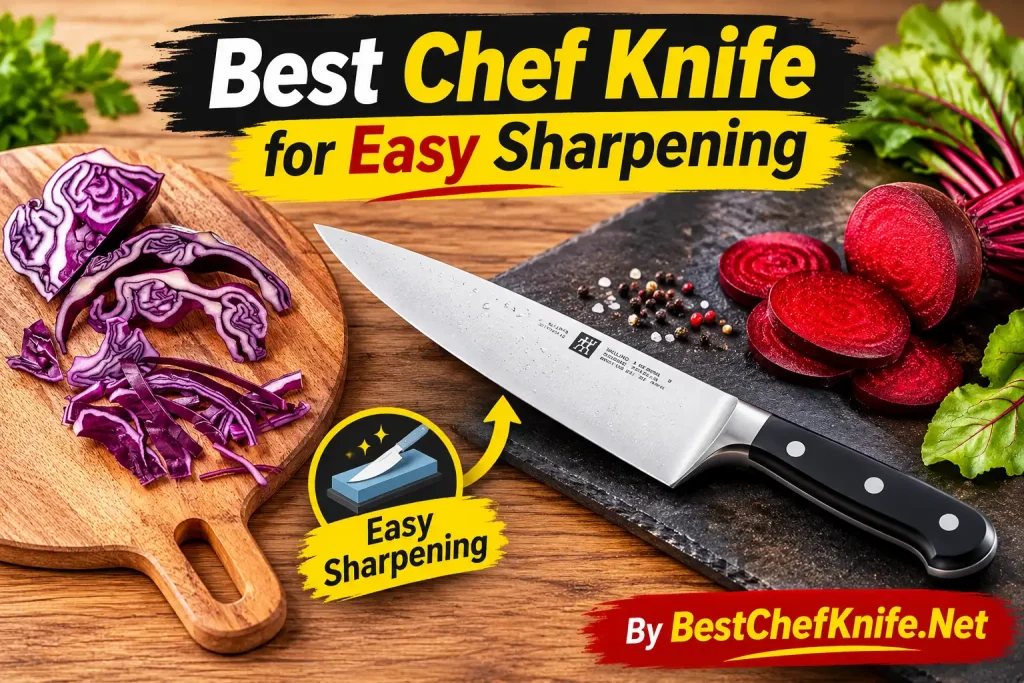
If you are learning to sharpen knives at home, a practical stainless-steel chef knife is often a sensible place to start. You do not necessarily need an expensive Japanese knife or an unusually hard blade to get good cutting performance.
In this guide, we look at three chef knives worth considering: the Victorinox Fibrox Pro 8-inch, WÜSTHOF Gourmet 8-inch, and ZWILLING Pro 8-inch. They offer different constructions and specifications, giving you a useful starting point when comparing everyday knives for home sharpening.
We will also explain how steel hardness affects sharpening, what equipment beginners actually need, and how to maintain a kitchen knife without removing more metal than necessary.
Quick Picks: Best Chef Knives for Easy Sharpening
| Knife | Best for | Main characteristic |
|---|---|---|
| Victorinox Fibrox Pro 8-inch | Everyday use and beginners | Practical, lightweight design |
| WÜSTHOF Gourmet 8-inch | A lighter German-style knife | Non-forged construction and 56 HRC |
| ZWILLING Pro 8-inch | Forged construction | Ice-hardened steel and 55–58 HRC |
A note about these recommendations: These are specification-based selections, not the results of a hands-on sharpening test. Manufacturer specifications help explain their construction and materials, but they do not establish a definitive ranking of sharpening speed or effort. Your sharpening technique and the condition of the edge will also affect the experience.
1. Victorinox Fibrox Pro 8-inch Chef’s Knife – Best Everyday Starting Point
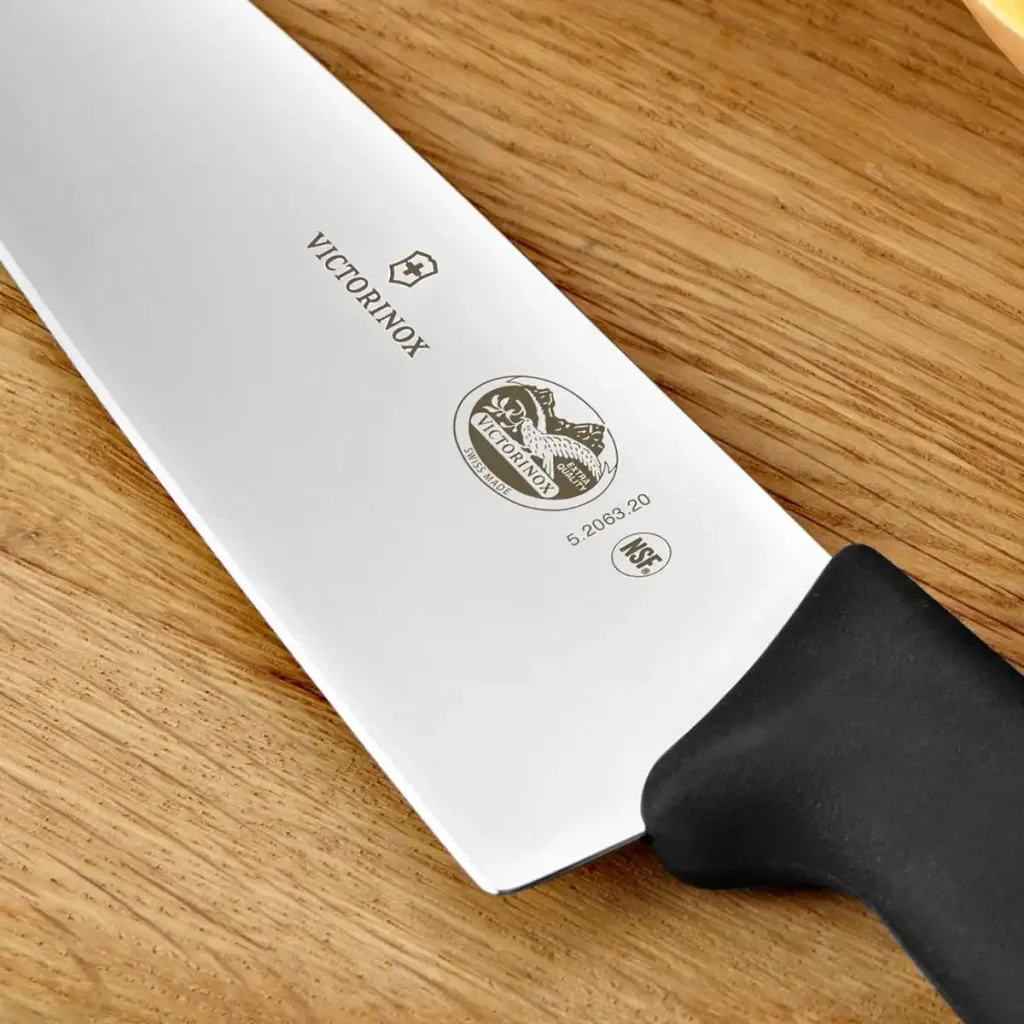
The Victorinox Fibrox Pro is a practical choice if you want a straightforward chef knife for everyday food preparation. Its lightweight construction, comfortable synthetic handle, and conventional stainless-steel design make it worth considering for someone learning basic knife maintenance.
It is not a premium showpiece, and that is part of its appeal. This knife is designed around everyday kitchen use rather than decorative finishes or elaborate construction.
Why consider it?
The Fibrox Pro has a stamped blade rather than a forged one. Its relatively lightweight design makes it comfortable for many routine kitchen tasks, including chopping vegetables, slicing meat, and preparing herbs.
Its synthetic Fibrox handle has a textured surface designed to provide a secure grip. That is useful when you are working through longer preparation sessions or learning to maintain consistent control of the knife.
For sharpening, its appeal is its practical, conventional stainless-steel construction. It is a reasonable option to consider if you want to learn whetstone sharpening without starting with a premium, harder Japanese-style knife.
However, the manufacturer’s published specifications should not be confused with a controlled sharpening comparison. They do not establish exactly how much time or effort this knife will require on a particular stone.
Key specifications
- Blade length: Approximately 7.9 inches
- Overall length: Approximately 13.4 inches
- Weight: Approximately 6.4 ounces
- Handle: Fibrox synthetic material
- Construction: Stamped
- Origin: Switzerland
What we like
- Lightweight design for everyday preparation.
- Textured handle for a secure grip.
- Practical stainless-steel construction.
- Less expensive than many premium forged knives.
- A sensible option for learning basic knife maintenance.
What to consider
- Its straightforward appearance may not appeal to buyers seeking a premium-looking knife.
- The stamped construction may not feel as substantial as a heavier forged knife.
- The published specifications alone do not prove that it is easier to sharpen than the other knives in this guide.
Best suited to: Home cooks who want a practical everyday chef knife and are beginning to learn how to maintain their own edges.
2. WÜSTHOF Gourmet 8-inch Chef’s Knife – Best Lightweight German-Style Option
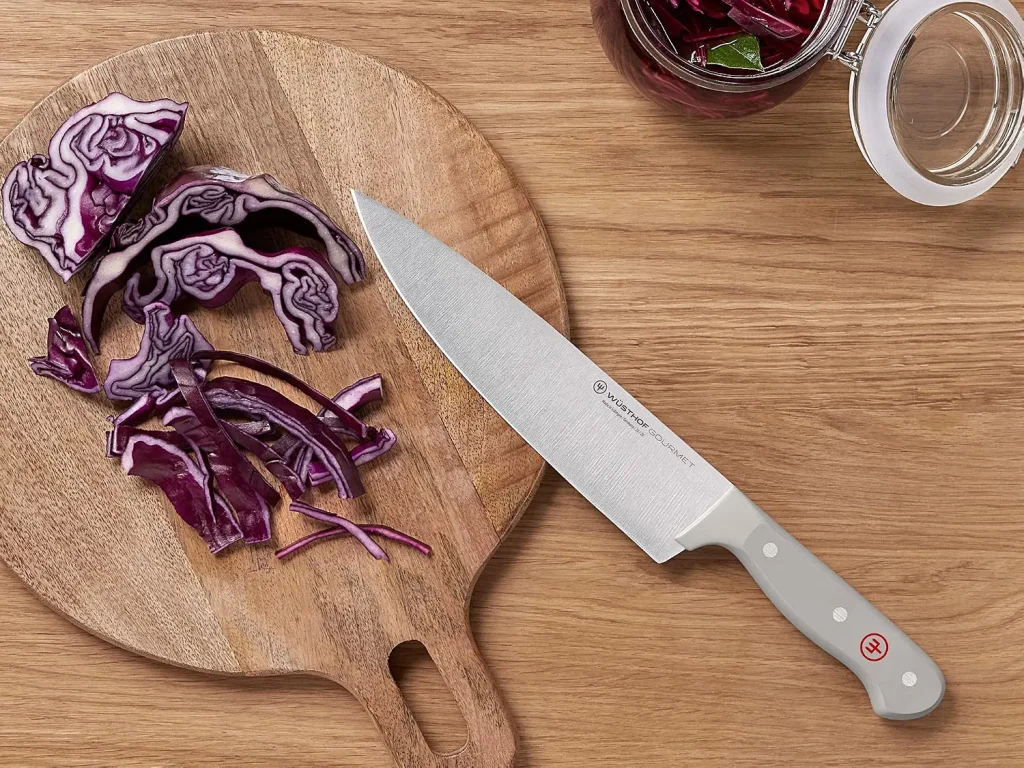
The WÜSTHOF Gourmet 8-inch is worth considering if you prefer a traditional German-style chef knife but do not necessarily want a heavier forged model.
Unlike the WÜSTHOF Classic range, the Gourmet line uses non-forged construction. It has a synthetic handle and a published hardness rating of 56 HRC.
That hardness figure is useful when comparing knife specifications, although it should not be treated as a guarantee of sharpening ease. Steel composition and heat treatment also influence how a blade responds to a sharpening stone.
Why consider it?
The Gourmet’s non-forged construction gives it a different feel from the heavier forged knives in WÜSTHOF’s range.
Its 56 HRC specification places it in a moderate hardness range for a Western-style stainless-steel kitchen knife. This can be a useful characteristic when considering everyday maintenance, edge durability, and sharpening equipment.
For a home cook who prefers conventional stainless-steel knives, the Gourmet offers a familiar style without moving into the harder steels commonly associated with some premium Japanese knives.
One important distinction: the Gourmet and Classic are different product lines. Do not assume their construction, weight, or specifications are interchangeable simply because they share the WÜSTHOF name.
Key specifications
- Blade length: 8 inches
- Handle length: Approximately 5.3 inches
- Hardness: 56 HRC
- Construction: Non-forged
- Handle: Synthetic
- Country of manufacture: Germany
What we like
- Traditional chef-knife shape.
- Published 56 HRC hardness specification.
- Non-forged construction.
- A useful alternative to heavier forged knives.
- Suitable for everyday kitchen preparation.
What to consider
- It does not have the same construction as WÜSTHOF’s forged Classic range.
- The handle and overall feel may not suit every hand.
- Its hardness rating alone cannot establish how easily it sharpens compared with another knife.
Best suited to: Home cooks who prefer a German-style chef knife and want a lighter alternative to a traditional forged model.
3. ZWILLING Pro 8-inch Chef’s Knife – Best Forged Construction
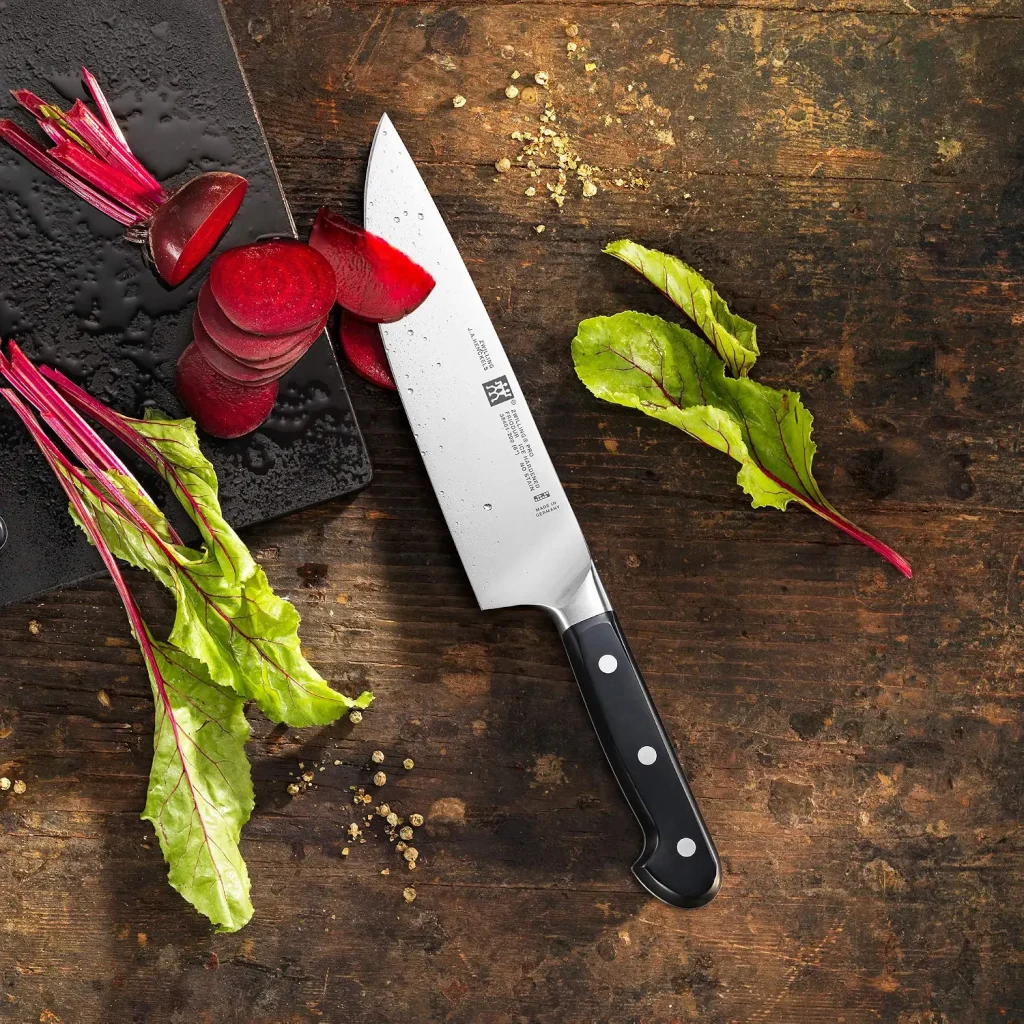
If you prefer a more substantial knife, the ZWILLING Pro 8-inch is another option worth considering.
It uses forged construction and ZWILLING’s FRIODUR ice-hardening process. The manufacturer lists its blade hardness in a range of 55–58 HRC.
These characteristics make it different from the stamped Victorinox and non-forged WÜSTHOF Gourmet. It is a more substantial option for someone who likes a traditional forged chef knife.
Why consider it?
The ZWILLING Pro combines a conventional chef-knife profile with a forged blade and a synthetic handle.
Its FRIODUR process is intended to improve the blade’s properties through ice hardening. The manufacturer lists a hardness range of 55–58 HRC, which provides a useful reference when comparing its specifications with other knives.
For home sharpening, the important point is that it remains a conventional stainless-steel chef knife rather than a particularly hard, delicate specialty blade.
That does not mean it will automatically be easier to sharpen than the Victorinox or WÜSTHOF. A fair comparison would require sharpening all three knives using the same abrasive, technique, and edge condition.
Key specifications
- Blade length: Approximately 7.87 inches
- Handle length: Approximately 5.12 inches
- Hardness: 55–58 HRC
- Construction: Forged
- Blade treatment: FRIODUR ice-hardened
- Handle: Synthetic
- Country of manufacture: Germany
What we like
- Forged construction.
- Traditional chef-knife profile.
- FRIODUR ice-hardening process.
- Published hardness range.
- Substantial feel compared with many lightweight stamped knives.
What to consider
- It may feel heavier than the Victorinox Fibrox Pro.
- It is not necessarily the best choice if you specifically want the lightest possible knife.
- Its forged construction does not automatically make it easier to sharpen.
- It may cost more than a basic everyday chef knife.
Best suited to: Home cooks who prefer a traditional forged knife and want a substantial everyday chef knife with conventional stainless-steel construction.
What Actually Makes a Chef Knife Easy to Sharpen?
A knife’s ability to take and maintain a sharp edge is not determined by one specification. Several characteristics work together.
Understanding these differences will help you make a better buying decision than simply choosing the knife with the lowest advertised HRC rating.
1. Steel composition
The type of steel used in a blade affects its hardness, wear resistance, corrosion resistance, and response to sharpening abrasives.
Some commonly used stainless-steel families in kitchen knives include:
- X50CrMoV15: A stainless-steel type commonly associated with European kitchen knives. It is used in knives designed around a balance of corrosion resistance, toughness, and everyday edge maintenance.
- VG-10: A Japanese stainless steel often used in premium kitchen knives. It can support good edge retention, depending on heat treatment and blade geometry.
- SG2/R2: A powdered stainless-steel family used in some premium Japanese knives. These blades are often designed for high wear resistance and edge retention.
The important distinction is that a steel’s name alone does not tell you exactly how easy the finished knife will be to sharpen.
Heat treatment, carbide structure, hardness, and the abrasive you use all matter.
2. Steel hardness (HRC)
HRC stands for Rockwell Hardness C. It is a measurement used to describe a material’s resistance to indentation.
In kitchen knives, hardness is often discussed because it influences the balance between edge stability, toughness, wear resistance, and maintenance.
A relatively softer blade may be more forgiving in some situations and can be easier to deburr, while a harder, wear-resistant steel may require more time or a suitable abrasive.
However, lower HRC does not automatically mean easier sharpening.
Two knives with the same hardness rating can behave differently because their steel composition and heat treatment may be different.
Use HRC as one comparison point, not the final buying decision.
3. Blade geometry
Blade geometry is another important consideration.
A knife with a thin blade behind the edge may cut efficiently, while a thicker blade can feel less responsive during certain cutting tasks.
Geometry also influences how much metal needs to be removed during sharpening and how easily you can maintain the existing edge.
For home cooks, a practical blade with a sensible edge profile is usually easier to maintain than a knife with an unusually delicate or specialized geometry.
4. Edge condition
Even a well-made knife can become difficult to sharpen if its edge is badly damaged.
A knife with a slightly dull edge generally needs less work than one with:
- Large chips.
- A badly rolled edge.
- An uneven bevel.
- Excessive previous sharpening.
- Significant corrosion or damage.
If your knife is only mildly dull, a normal maintenance sharpening may be enough. If it has large chips or a heavily damaged edge, you may need a coarser abrasive or professional assistance.
German vs. Japanese Chef Knives: Which Is Easier to Sharpen?
This is a common question among home cooks.
German and Japanese knives often have different design priorities, but neither category is automatically easier to sharpen.
| Characteristic | Many German-style knives | Many Japanese-style knives |
|---|---|---|
| Typical hardness | Moderate | Often higher |
| Steel options | Commonly stainless steels | Stainless and carbon steels |
| Blade design | Often more robust | Often thinner and more specialized |
| Edge retention | Varies by model | Varies by model |
| Sharpening | Often forgiving | May require more attention to technique |
These are broad tendencies, not universal rules. There are soft Japanese knives and relatively hard German knives.
If you are a beginner, a conventional stainless-steel knife with a moderate hardness rating can be a sensible starting point. As your sharpening skills improve, you can explore harder steels and more specialized blade designs.
What Sharpening Stone Should a Beginner Buy?
You do not need a large collection of expensive sharpening stones to maintain an ordinary kitchen knife.
For most beginners, a good-quality combination whetstone with a 1,000-grit side is a practical starting point.
Understanding sharpening grits
| Grit | Main purpose |
|---|---|
| 200–400 | Repairing damaged edges and removing more material |
| 800–1,000 | General sharpening and restoring a dull edge |
| 2,000–3,000 | Refining an existing edge |
| 5,000–8,000 | Fine polishing and finishing |
A 1,000-grit stone is generally sufficient for routine sharpening on a reasonably maintained kitchen knife.
You do not need to start with an extremely fine stone. A polished edge is not automatically better for every kitchen task.
Do you need a coarse stone?
Not necessarily.
A coarse stone is useful when a knife has significant damage, large chips, or an edge that needs substantial reshaping.
For a knife that has simply lost some sharpness, starting with a coarse stone removes more material than necessary.
A practical approach is to begin with a medium-grit stone and add a coarse stone only when your maintenance needs justify it.
Should you buy a pull-through sharpener?
Pull-through sharpeners are convenient, especially for people who do not want to learn whetstone technique.
However, their results depend on the sharpener’s design and the knife being used. Some models remove more material than necessary or use fixed angles that may not suit every blade.
If you plan to maintain your knives for years, learning basic whetstone sharpening gives you more control over the process.
For an inexpensive everyday knife, a suitable pull-through sharpener may still be a practical option if you use it according to the manufacturer’s instructions.
How to Sharpen a Chef Knife at Home?
<figure>
</figure>
You do not need professional equipment to learn basic sharpening, but you do need patience and a consistent technique.
Here is a straightforward starting process for a conventional double-bevel chef knife.
Step 1: Prepare your sharpening stone
Follow the stone manufacturer’s instructions.
Some water stones need soaking, while others are designed to be used after simply wetting the surface. Do not assume every whetstone should be soaked.
Place the stone on a stable, non-slip base.
Step 2: Understand the existing edge angle
Most kitchen knives have a bevel on each side of the blade.
Try to maintain the manufacturer’s intended edge geometry rather than choosing an arbitrary angle.
If you are unsure about the existing angle, use a suitable angle guide or seek guidance for your particular knife.
Step 3: Sharpen one side
Hold the blade steadily and move it across the stone using controlled strokes.
Apply consistent pressure and work along the entire cutting edge, from heel to tip.
Avoid pressing too hard. Excessive pressure can make it more difficult to maintain a consistent angle.
Step 4: Check for a burr
A burr is a small ridge of metal that forms along the opposite side of the edge as you sharpen.
It can help indicate that you have reached the edge, but you should not create a large burr unnecessarily.
Use care when checking for one. Never slide your finger along the cutting edge.
Step 5: Repeat on the other side
Turn the knife over and repeat the process.
Try to keep the bevel consistent and avoid removing unnecessary material.
Step 6: Refine and deburr
Use lighter, controlled strokes to refine the edge and remove the remaining burr.
Clean the blade and stone according to their manufacturers’ instructions.
Before using the knife, test its cutting performance carefully on an appropriate food item or a suitable cutting-test material.
Important: If your knife has a single-bevel edge, significant chips, or a specialized blade profile, this general double-bevel process may not be appropriate.
Sharpening vs. Honing: What Is the Difference?
These two terms are often used interchangeably, but they describe different maintenance activities.
Sharpening removes material from the blade to create a new cutting edge.
Honing is a maintenance process intended to realign or refresh an edge, depending on the tool and technique used. Some honing tools also remove a small amount of metal.
A honing rod does not replace sharpening indefinitely. If a knife has become genuinely dull, honing alone will not restore its original cutting performance.
For most home cooks, the sensible routine is to clean and dry the knife after use, maintain its edge when needed, and sharpen it when ordinary maintenance no longer restores satisfactory cutting performance.
Common Mistakes When Buying a Chef Knife for Easy Sharpening
Choosing the wrong knife can make maintenance unnecessarily frustrating. Here are some mistakes worth avoiding.
Choosing a knife based only on HRC
A lower hardness rating does not automatically make a knife easier to sharpen. Steel composition, heat treatment, and geometry matter too.
Assuming expensive knives are better
A premium knife may offer excellent cutting performance, but it is not necessarily the best choice for someone learning to sharpen.
A practical everyday knife can be a better starting point.
Buying a very hard knife without considering maintenance
Some harder steels offer excellent edge retention, but they may require appropriate abrasives and more careful technique.
Think about your willingness to maintain the knife before buying.
Using the wrong sharpening equipment
A sharpening stone or pull-through sharpener should be suitable for the blade and its edge geometry.
Avoid using aggressive sharpening equipment unnecessarily.
Waiting until the edge is badly damaged
Regular maintenance is generally easier than restoring a severely neglected edge.
You should not wait until a knife struggles with basic cutting tasks before paying attention to its condition.
How to Keep Your Chef Knife Sharp for Longer?
Good maintenance can reduce how frequently you need to sharpen your knife.
A few simple habits make a difference:
- Use an appropriate cutting board: Wood and suitable plastic boards are generally better choices than glass, stone, or ceramic surfaces.
- Avoid cutting frozen food: Unless the knife is specifically designed for it, frozen ingredients can damage the edge.
- Wash and dry the knife after use: Do not leave it sitting wet in the sink.
- Store it safely: Use a knife block, blade guard, or suitable magnetic storage system.
- Avoid using the edge for scraping: Turn the knife over and use the spine when moving chopped ingredients across the board.
- Maintain the edge regularly: Sharpen when necessary rather than waiting for severe dullness.
These habits help protect the cutting edge and make long-term maintenance easier.
Frequently Asked Questions
Final Verdict: Which Chef Knife Should You Choose?
The best choice depends on what you value most.
- Choose the Victorinox Fibrox Pro 8-inch if you want a practical everyday chef knife and a sensible starting point for learning knife maintenance.
- Choose the WÜSTHOF Gourmet 8-inch if you prefer a traditional German-style knife with non-forged construction and a published 56 HRC hardness rating.
- Choose the ZWILLING Pro 8-inch if you prefer a more substantial forged knife with FRIODUR ice-hardened construction.
If you are buying your first chef knife and plan to learn whetstone sharpening, I would start by considering the Victorinox Fibrox Pro. It offers a practical balance of everyday usability and straightforward construction.
The most important thing is not to chase the lowest HRC number or assume that one country’s knives are always easier to sharpen. Choose a knife that feels comfortable, suits your budget, and can be maintained with the sharpening equipment you are prepared to use.
A well-maintained, practical chef knife is more useful in a home kitchen than an expensive knife that you do not feel confident maintaining.
Affiliate Disclosure
This article may contain affiliate links. If you purchase through one of these links, we may earn a commission at no additional cost to you. Our product selections and editorial recommendations are not determined solely by commission rates.