Best Chef Knife for Small Kitchens (2027): 3 Space-Saving Picks
Cooking in a small kitchen often means working with limited counter space, a compact cutting board, and not much room for storing kitchen tools. A large chef knife can feel awkward when you are preparing vegetables on a small board or trying to fit everything into a crowded drawer.
The good news is that you do not need a large collection of knives to prepare everyday meals. One well-chosen chef knife can handle most chopping, slicing, dicing, and mincing tasks without taking up unnecessary space.
But choosing the right knife for a small kitchen is not simply about buying the shortest blade. You also need to consider how much cutting room it requires, whether it is comfortable for everyday use, how easily you can store it, and whether it can handle different ingredients.
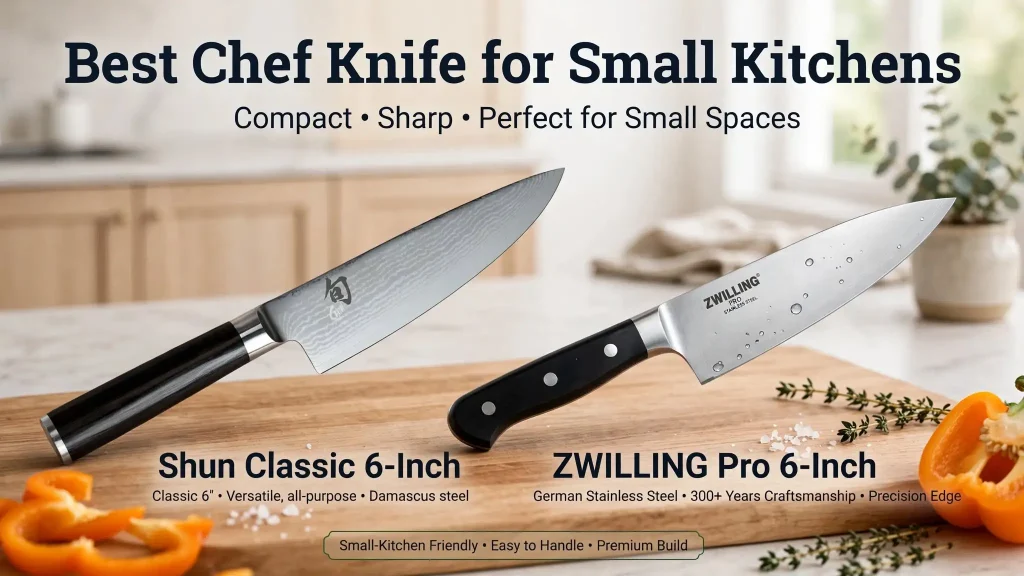
In this guide, we compare three chef knives worth considering for smaller kitchens:
- ZWILLING Pro 6-inch Chef’s Knife: A compact all-purpose option with a forged blade and curved bolster.
- Victorinox Fibrox Pro 8-inch Chef’s Knife: A practical, lightweight choice if you want one versatile knife for a wide range of tasks.
- Shun Classic 6-inch Chef’s Knife: A premium compact option for cooks who prefer a shorter Japanese-style blade.
Each knife has a different purpose. The right choice depends on how much space you have, what you cook, and how you prefer to work.
Quick Picks: Best Chef Knives for Small Kitchens
| Knife | Best for | Main advantage | Main compromise |
|---|---|---|---|
| ZWILLING Pro 6-inch | Compact everyday preparation | Short blade and forged construction | Higher price than basic options |
| Victorinox Fibrox Pro 8-inch | One versatile kitchen knife | Lightweight and useful for larger ingredients | Needs more cutting-board and storage space |
| Shun Classic 6-inch | Premium compact cutting | Short blade, Japanese construction, and precise edge | Requires careful handling and maintenance |
Our quick recommendation: Choose the ZWILLING Pro 6-inch if your cutting board and storage space are limited. Consider the Victorinox if you have enough room for an 8-inch blade and want greater versatility. The Shun is worth considering if you prefer a premium compact knife.
1. ZWILLING Pro 6-Inch Chef’s Knife
Best for: Compact everyday preparation
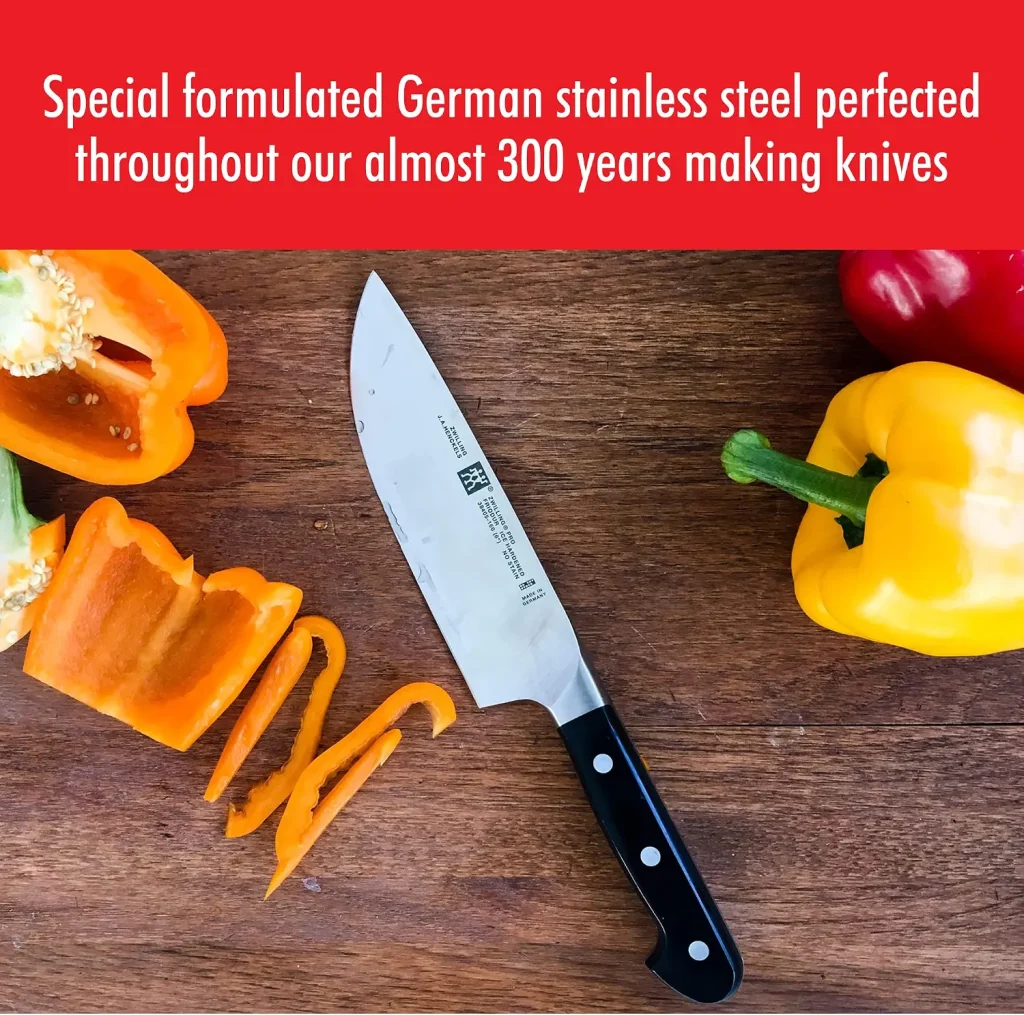
When kitchen space is limited, a 6-inch chef knife can make everyday preparation easier. The ZWILLING Pro 6-inch offers a shorter blade than the traditional 8-inch chef knife while retaining a familiar Western chef-knife design.
It is designed for chopping, slicing, and dicing, making it suitable for many routine kitchen tasks. Its forged construction and curved bolster also give it a more substantial feel than some lightweight stamped knives.
Why it works in a small kitchen
The main advantage is its compact blade. You have less blade length to manage when working on a small cutting board, and the knife is easier to accommodate in a compact storage setup than a longer chef knife.
ZWILLING also uses a curved bolster designed to support a pinch grip. This can be useful for cooks who hold the knife near the blade while cutting.
The manufacturer’s specifications list a 6.30-inch blade and a 4.53-inch handle. The knife is made in Germany and has a forged construction with a plastic handle.
Where it may fall short
A 6-inch blade cannot provide the same cutting reach as an 8-inch knife. When preparing large vegetables, melons, or bigger portions of meat, you may need additional cutting strokes.
It is also not the cheapest option for someone buying a first chef knife. If you mainly prepare simple meals, a more affordable knife may provide better value.
Key specifications
| Feature | Details |
|---|---|
| Blade length | 6.30 inches |
| Handle length | 4.53 inches |
| Handle material | Plastic |
| Construction | Forged |
| Blade hardness | 55–58 HRC |
| Origin | Germany |
| Best suited for | Compact everyday preparation |
Consider it if: You want a shorter chef knife that can handle everyday chopping, slicing, and dicing without requiring a large cutting area.
Think twice if: You regularly prepare large ingredients or prefer the reach of a full-size 8-inch blade.
2. Victorinox Fibrox Pro 8-Inch Chef’s Knife
Best for: One versatile knife in a small kitchen
A small kitchen does not always mean you should buy the smallest knife available. Sometimes, a single versatile 8-inch chef knife is more practical than buying several smaller knives for different jobs.
The Victorinox Fibrox Pro 8-inch is worth considering if you have enough cutting-board space and want one dependable knife for most everyday preparation.
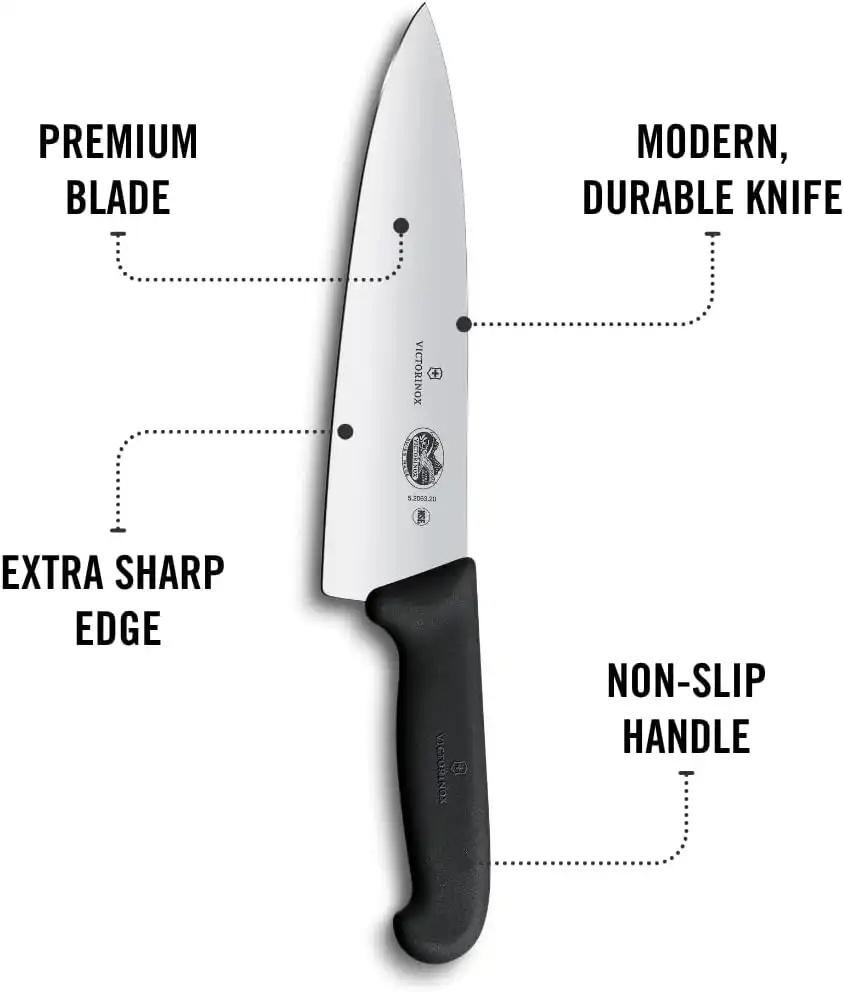
It has a stamped stainless-steel blade and a textured thermoplastic elastomer (TPE) handle. The design focuses on practical everyday use rather than premium decorative features.
Why it works in a small kitchen
The biggest advantage is versatility. An 8-inch chef knife can handle a wide range of ingredients, from onions and carrots to larger vegetables and boneless meat.
That means you may not need to purchase several separate knives for routine preparation.
Weight is another useful consideration. Victorinox lists this extra-wide 8-inch model at approximately 6.4 ounces. Its relatively light construction may appeal to cooks who do not want a heavy knife.
The textured handle is designed to provide a non-slip grip, while the broad blade offers useful space for guiding your cutting hand.
Where it may fall short
An 8-inch blade needs more room to work comfortably. If your cutting board is very small, the knife may feel oversized, particularly when preparing larger ingredients.
It also requires more storage length than a 6-inch knife. Measure your drawer or knife storage area before ordering.
The Fibrox Pro is a practical workhorse, but it does not have the same forged construction or premium finish as more expensive alternatives.
Key specifications
| Feature | Details |
|---|---|
| Blade length | Approximately 7.9 inches |
| Weight | Approximately 6.4 oz |
| Handle material | Thermoplastic elastomer (TPE) |
| Construction | Non-forged |
| Country of origin | Switzerland |
| Best suited for | Versatile everyday preparation |
Consider it if: You want one knife that can handle most kitchen tasks and have enough board space to use an 8-inch blade comfortably.
Think twice if: Your cutting board, drawer, or storage area is extremely small.
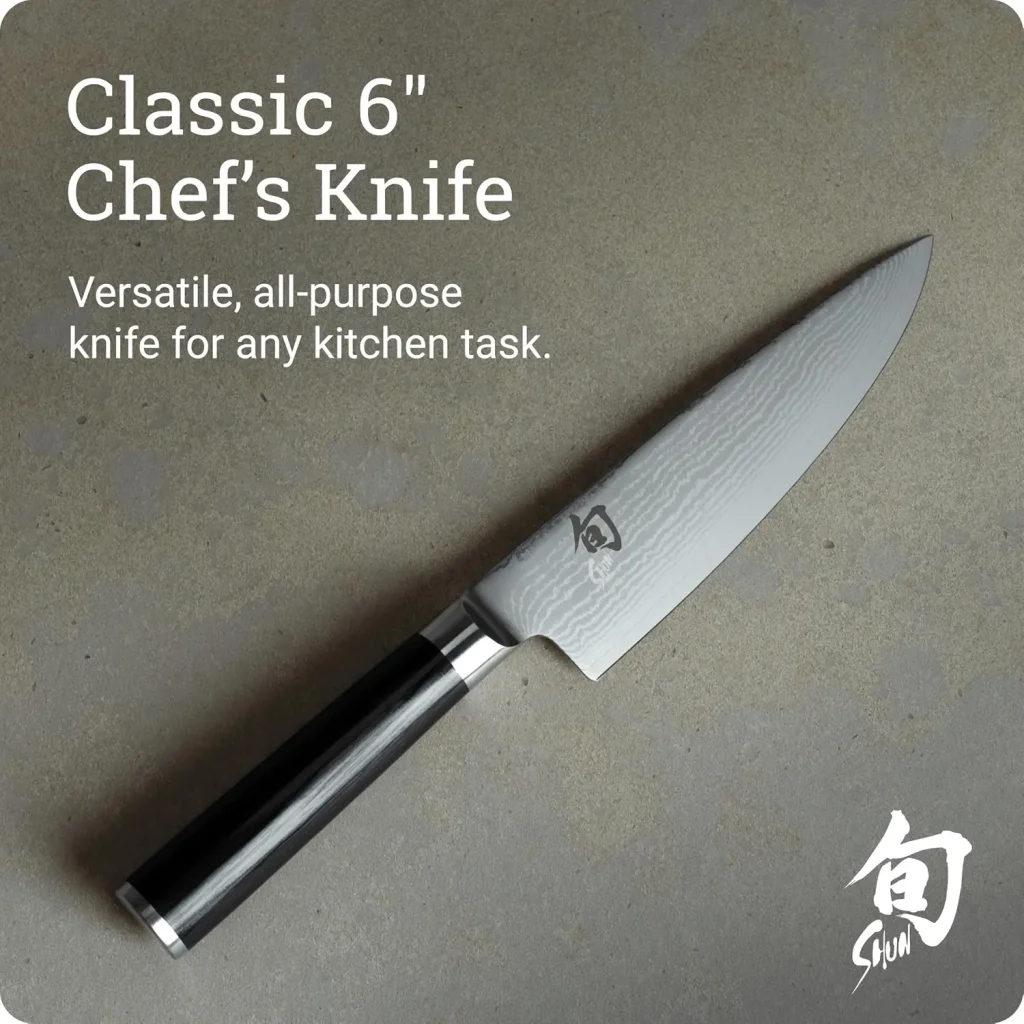
3. Shun Classic 6-Inch Chef’s Knife
Best for: Premium compact cutting
If you prefer a shorter knife but do not want to compromise on premium construction, the Shun Classic 6-inch chef’s knife is another option.
Shun is known for its Japanese kitchen knives, and the Classic range combines a VG-MAX steel core with layered stainless-steel cladding and a traditional D-shaped Pakkawood handle.
Its 6-inch blade makes it suitable for cooks who prefer a compact cutting tool for everyday food preparation.
Why it works in a small kitchen?
The shorter blade is easier to accommodate on a compact cutting board than a full-size 8-inch knife.
It is suitable for tasks such as slicing vegetables, chopping herbs, dicing onions, and preparing smaller portions of food.
The manufacturer’s product information describes the 6-inch Classic as a compact knife designed for control and everyday preparation. Its D-shaped handle provides a traditional Japanese-style grip.
The premium construction may also appeal to someone who wants a long-term kitchen tool rather than a basic entry-level knife.
Where it may fall short?
The main disadvantage is its price. A premium Japanese knife may not be necessary if you cook occasionally or mainly prepare simple meals.
Its thinner, harder cutting edge also requires sensible handling. Avoid twisting the blade through hard ingredients, cutting frozen food, or using it against bones.
You should also avoid throwing it into a crowded drawer. A blade guard or suitable storage system is a sensible choice.
Key Specifications
| Feature | Details |
|---|---|
| Blade length | 6 inches |
| Steel core | VG-MAX |
| Handle material | Pakkawood |
| Handle shape | D-shaped |
| Construction | Japanese layered blade construction |
| Best suited for | Premium compact food preparation |
Consider it if: You want a premium 6-inch chef knife with Japanese-style construction and a compact blade.
Think twice if: You have a limited budget or prefer a knife that requires less careful handling.
Check the Shun Classic 6-inch chef’s knife
What Makes a Chef Knife Suitable for a Small Kitchen?
A compact kitchen creates different challenges from a large kitchen. You may have limited room for cutting, fewer storage options, and less space to keep several knives.
Before choosing a chef knife, consider these five factors.
1. Blade Length
Blade length is one of the first things to consider.
An 8-inch chef knife is versatile, but it needs enough room to move comfortably across your cutting board. A 6-inch knife may be easier to manage when working on a compact surface.
However, a shorter blade is not automatically better. If you frequently prepare large vegetables or meat portions, an 8-inch knife may save time.
Think about the ingredients you prepare most often rather than choosing a blade based only on its size.
2. Overall Knife Length
The blade is not the only part that takes up space. The handle also contributes to the knife’s total length.
Before buying, check the manufacturer’s overall-length measurement. This is particularly important if you plan to store your knife in a kitchen drawer.
Measure the available space rather than assuming a knife will fit because its blade is only 6 inches long.
3. Weight and Balance
A heavy knife can feel tiring during repetitive preparation, while a lighter knife may be easier to move around a small cutting board.
Balance matters too. A knife should feel comfortable in your hand without requiring constant adjustments.
Do not assume that a lightweight knife is always better. Some cooks prefer the more substantial feel of a forged knife.
4. Storage Options
Storage is often overlooked when buying a chef knife for a small kitchen.
A knife block can take up valuable counter space, while a loose knife in a drawer can damage its edge and create a safety risk.
Consider alternatives such as:
- A blade guard or knife sheath.
- A drawer knife organizer.
- A magnetic wall-mounted knife strip, installed securely.
- A compact knife block if you have available counter space.
Always make sure the blade is protected and cannot move freely against other utensils.
5. Versatility
When storage space is limited, buying fewer but more useful kitchen tools can make sense.
A versatile chef knife can handle many routine jobs, including:
- Chopping vegetables.
- Slicing fruit.
- Dicing onions.
- Mincing garlic and herbs.
- Preparing boneless meat.
- Cutting sandwiches and other everyday ingredients.
You may still need a serrated bread knife for crusty loaves and a small paring knife for detailed work. However, you do not necessarily need a large knife collection.
6-Inch vs. 8-Inch Chef Knife: Which Is Better for a Small Kitchen?
Both sizes can work well, but they serve slightly different needs.
| Feature | 6-inch chef knife | 8-inch chef knife |
|---|---|---|
| Cutting-board space | Needs less room | Needs more room |
| Storage | Easier to accommodate | Requires more storage length |
| Large ingredients | Less cutting reach | More efficient for large items |
| Everyday preparation | Suitable for many tasks | More versatile across ingredient sizes |
| Compact kitchens | Often a convenient choice | Works if counter and storage space allow |
Choose a 6-inch chef knife if:
- You have a small cutting board.
- You prepare mostly vegetables and smaller portions.
- Your kitchen drawers have limited space.
- You prefer a compact knife.
- You want a shorter blade for everyday preparation.
Choose an 8-inch chef knife if:
- You regularly prepare large ingredients.
- You want one knife for a wider range of tasks.
- Your cutting board has enough working space.
- You have suitable drawer or wall storage.
- You prefer longer cutting strokes.
For many compact kitchens, a 6-inch knife is a practical starting point. But if you cook for several people or prepare large ingredients regularly, an 8-inch model may be more useful.
Chef Knife vs. Santoku: Which Is Better for a Small Kitchen?
A santoku is another useful option if you want a compact kitchen knife.
It is a Japanese-style knife commonly used for slicing, dicing, and chopping. Many santoku knives have a shorter blade and a flatter cutting profile than traditional Western chef knives.
A chef knife usually has a more pronounced curve, making it suitable for rocking cuts. A santoku generally works well with a more direct chopping or push-cutting motion.
| Feature | Chef knife | Santoku |
|---|---|---|
| Blade profile | More curved | Generally flatter |
| Common size | 6–10 inches | 5.5–7 inches |
| Cutting style | Rocking, slicing, chopping | Chopping, slicing, push cutting |
| Storage | Depends on blade size | Compact models can be easier to store |
| Best suited for | General-purpose preparation | Vegetables, fish, and everyday slicing |
Neither knife is automatically better for a small kitchen.
If you prefer a traditional rocking motion, choose a chef knife. If you mostly chop vegetables and like a flatter blade, a compact santoku may be worth considering.
How Many Knives Do You Really Need in a Small Kitchen?
You do not need a large knife block to prepare everyday meals.
For many home cooks, a small collection of two or three useful knives is enough.
1. Chef Knife
Your main knife should handle most chopping, slicing, and dicing tasks. Choose a 6-inch or 8-inch model depending on your available workspace.
2. Paring Knife
A small paring knife is useful for peeling fruit, trimming vegetables, and handling detailed cutting tasks that are awkward with a chef knife.
3. Bread Knife
If you regularly eat crusty bread, a serrated bread knife can be useful. Its long blade cuts through crust without requiring the same pressure as a straight-edged knife.
You do not need to buy all three immediately. Start with a chef knife that suits your cooking habits, then add other knives only when you have a genuine need.
Smart Knife Storage Ideas for Small Kitchens
Choosing a compact chef knife is only part of the solution. You also need a safe place to keep it.
Use a Blade Guard
A blade guard protects the cutting edge and makes drawer storage more practical. It is often a simple option when you do not have enough counter space for a knife block.
Check that the guard fits the exact knife dimensions.
Try a Drawer Knife Organizer
A dedicated drawer organizer keeps knives separated from other utensils. It also makes it easier to find the knife you need without reaching into a crowded drawer.
Measure the drawer before purchasing an organizer.
Install a Magnetic Knife Strip
A magnetic knife strip can free up counter and drawer space. It should be mounted securely and positioned where children cannot easily reach it.
Make sure the knife is held firmly and cannot slide or fall.
Avoid Loose Drawer Storage
Never leave sharp knives loose among forks, spoons, and other utensils. This can damage the cutting edge and increase the chance of accidental cuts.
Common Mistakes to Avoid When Buying a Chef Knife for a Small Kitchen
Choosing the Shortest Knife Automatically
A very short blade may save space but can become inconvenient when preparing larger ingredients. Choose a size that matches your regular cooking.
Ignoring Overall Length
The handle adds to the knife’s total length. Check the complete dimensions before buying, especially if drawer space is limited.
Buying a Large Knife Block
A large knife block may look attractive, but it can occupy valuable counter space. Consider a blade guard or drawer organizer instead.
Buying Too Many Knives
You do not need a separate knife for every kitchen task. A versatile chef knife can handle most daily preparation.
Forgetting About Cutting-Board Size
Even a compact knife needs enough space for safe cutting. Make sure your board is stable and large enough for the ingredients you prepare.
How to Maintain Your Chef Knife in a Small Kitchen?
A small kitchen does not make knife maintenance difficult. A few basic habits can keep your knife in good condition.
Clean It After Use
Wash your knife according to the manufacturer’s care instructions. For most quality chef knives, hand washing with mild soap and warm water is a sensible routine.
Dry it before storing it to reduce the risk of corrosion or staining.
Use a Suitable Cutting Board
Wooden and plastic cutting boards are generally better choices than glass, stone, or ceramic surfaces.
Hard surfaces can damage a knife’s cutting edge more quickly.
Keep the Blade Sharp
A dull knife may require more pressure, making cutting less comfortable and less controlled.
Use an appropriate sharpening method or seek professional sharpening when needed. Follow the manufacturer’s recommendations for the knife’s steel and edge.
Store It Safely
Use a blade guard, drawer organizer, or securely mounted magnetic strip. Avoid placing the knife loose in a drawer.
Frequently Asked Questions
Final Verdict: Which Chef Knife Should You Choose?
The best chef knife for a small kitchen should make cooking easier without taking up unnecessary space.
Here is our recommendation based on the three options:
- Choose the ZWILLING Pro 6-inch if you want a compact, forged chef knife for everyday preparation.
- Choose the Victorinox Fibrox Pro 8-inch if you want one versatile knife and have enough room for a full-size blade.
- Choose the Shun Classic 6-inch if you prefer a premium compact knife with Japanese-style construction.
For most kitchens with genuinely limited cutting and storage space, a 6-inch chef knife is a sensible place to start. If your cooking involves larger ingredients or family-sized portions, an 8-inch knife may be worth the extra space.
Before buying, measure your cutting board and storage area, check the knife’s overall dimensions, and think about the ingredients you prepare most often.
A small kitchen does not need a large collection of knives. It needs a few useful tools that fit the space and make everyday cooking comfortable.
Affiliate Disclosure
Some links in this article may be affiliate links. If you purchase through these links, we may earn a commission at no additional cost to you. This does not influence our selection criteria or the information presented. We aim to provide practical comparisons so readers can make informed purchasing decisions.